For a while, GEO sat in that awkward category of marketing language that sounded important but still felt slightly unfinished. People knew AI search was changing visibility. They knew tools like ChatGPT, Gemini, Perplexity and AI Overviews were starting to shape discovery. But a lot of the conversation still felt broad, fuzzy, and a bit theoretical.
That is changing quickly.
One of the clearest signals came this week when Search Engine Land covered IBM’s view that brands now need a 12-part GEO playbook. The framing matters because it treats Generative Engine Optimisation less like a trend to observe and more like an operating model to build. At the same time, Search Engine Land’s recent coverage of query fan-out has made the mechanics of AI visibility more concrete, while Screaming Frog has published a workflow for turning website content into markdown at scale for LLM and RAG use cases. Put together, the message is simple: AI search visibility is becoming something brands need to systemise, not just discuss.
The old SEO model focused heavily on rankings, clicks, and traffic. That still matters. But AI search changes the shape of the game. Machines are now summarising, comparing, selecting, and recommending before a user ever reaches your website. If your content is not easy to retrieve, interpret, trust, and reuse, you risk being skipped before the click even has a chance to happen.
So what should a practical GEO operating model actually look like?
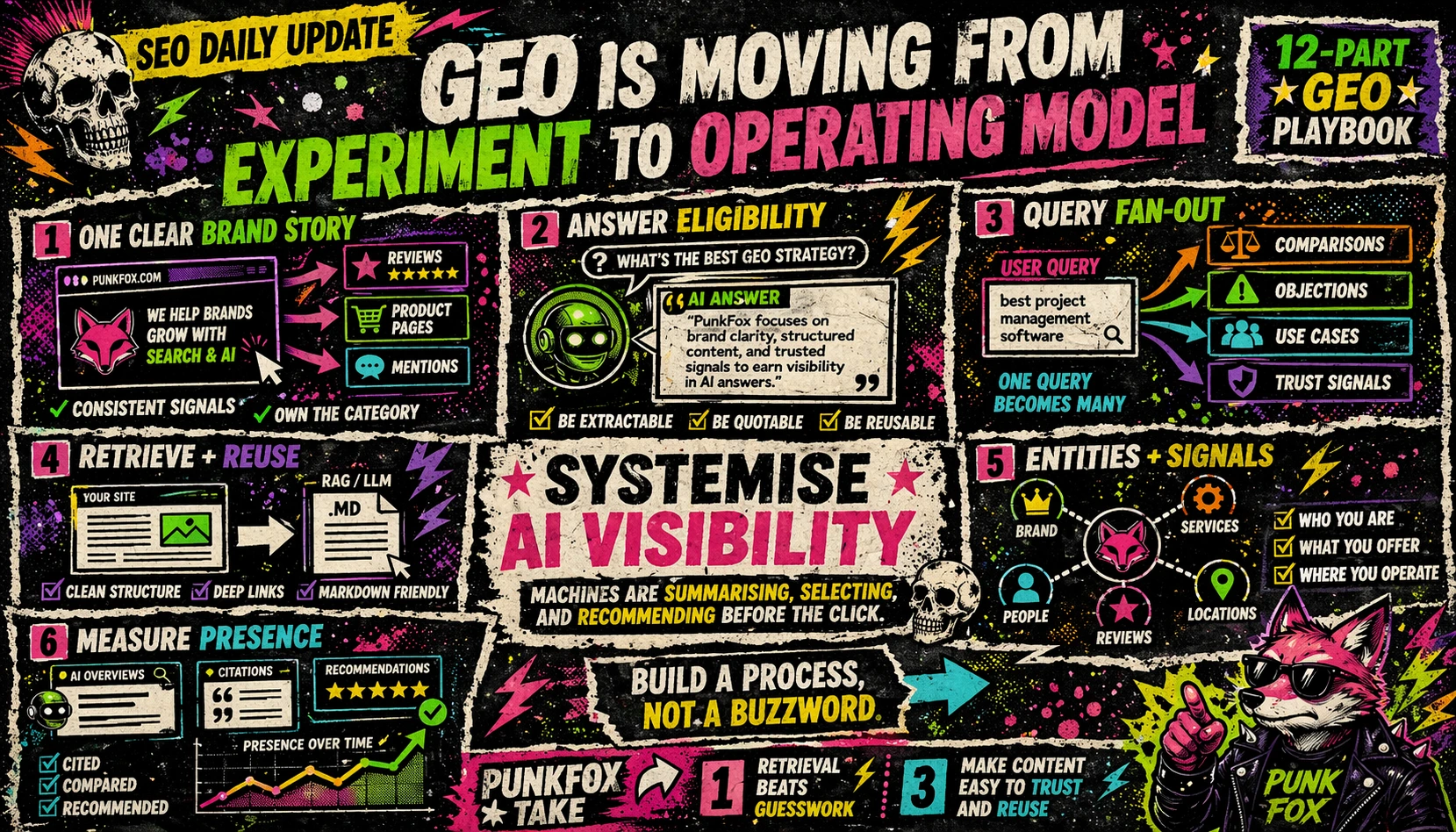
Here is a PunkFox version of a 12-part GEO playbook that makes the shift feel useful rather than abstract.
1. Start with one clear brand story
AI systems are far better at spotting patterns than they are at forgiving contradictions. If your homepage says one thing, your product pages say another, your reviews emphasise something else, and your third-party mentions paint a different picture again, your brand becomes harder to interpret confidently. Search Engine Land’s recap of IBM’s talk puts this right at the centre of the GEO challenge: brands need consistent signals across their own site and the wider ecosystem.
This means your first job is not to optimise every page individually. It is to make sure the overall story is coherent. What do you want to be known for? What category do you want to own? What strengths should an AI system repeatedly associate with you?
2. Build for answer eligibility, not just traffic
Traditional SEO often asks, “How do we get the click?” GEO adds another question: “How do we become part of the answer?”
That changes the editorial mindset. Content that only works when someone lands on the page and reads every word is less useful in an AI-mediated environment than content that can be extracted, summarised, and quoted accurately. IBM’s framing, as reported by Search Engine Land, is that brands are now marketing to machines as well as humans. That is a big shift, and it means answer eligibility becomes a strategic objective in its own right.
3. Map the query fan-out around your core topics
One of the most useful recent concepts in AI search coverage is query fan-out. Search Engine Land’s reporting explains how one user query can expand into several hidden sub-queries, comparisons, constraints, and related angles before an AI system produces its answer.
That matters because your page may not lose visibility because it failed to target the main keyword. It may lose visibility because it failed to cover the support questions the machine considered while building the answer.
A proper GEO playbook should map not only the primary commercial term, but also the surrounding questions, objections, comparisons, use cases, trust signals, and scenario-based variants that an AI system is likely to retrieve.
4. Make content easier to retrieve and reuse
This is where structure starts to matter as much as substance. If your best content is trapped inside awkward page templates, fragile JavaScript behaviour, hidden tabs, bloated layouts, or messy exports, it becomes harder for systems to interpret and reuse reliably.
That is why Google’s recent guidanceon Read more deep links is more important than it first sounds. Google is effectively saying that if you want the search engine to send people deeper into a page, that page has to behave clearly. This aligns with their broader crackdown on manipulative technical behaviors, like the recent back button hijacking spam policy.
5. Treat entities as seriously as keywords
Keywords still matter, but AI search is heavily influenced by entity understanding. That means your brand, products, services, people, locations, categories, and supporting claims all need to be understandable as connected things, not just words repeated on a page.
A mature GEO process should ask whether your site clearly defines who you are, what you offer, where you operate, how you differ, and what evidence supports those claims. The more clearly those entities are expressed, the easier it becomes for AI systems to join the dots.
6. Align owned, earned, and third-party signals
One reason IBM’s framing is useful is that it pushes brands beyond the website. Your GEO footprint is not built from owned content alone. AI systems may pull from reviews, news mentions, directories, social platforms, comparison sites, marketplace listings, and forums. If those sources conflict with your positioning, it weakens the overall picture.
That means GEO is partly a digital PR and reputation discipline. It is not enough to write a clean service page if the rest of the web sends mixed signals about your authority, quality, or category fit.
7. Build content around commercial decision moments
AI systems are often used at exactly the point where a user wants clarity. They are asked to compare, shortlist, explain, recommend, and simplify. That means the best GEO content is often not broad awareness content. It is content that helps with choice.
Think comparison pages, buyer guides, category explainers, objection-handling sections, pricing context, service-fit guidance, and pages that help a machine understand when your brand is the right answer and when it is not. The clearer the decision support, the more useful the content becomes in AI-driven journeys.
8. Make technical formatting part of the strategy
This is where the Screaming Frog workflow becomes especially relevant. Their new guide on extracting website content into markdown at scale for LLM and RAG use cases points to a very practical side of GEO: content operations. If teams need to prepare, audit, repurpose, or test content for AI retrieval, they need formats and workflows that make that possible.
That does not mean every business needs a complex AI content pipeline tomorrow. It does mean the brands taking AI visibility seriously will increasingly think about content formats, extractability, version control, and reusability as part of the operating model.
9. Audit for coverage gaps, not just ranking gaps
Most SEO audits ask which keywords are underperforming. GEO audits should also ask which decision points are missing, which sub-questions are uncovered, and where a machine would have to go elsewhere to complete the answer.
This is a subtle but important shift. Instead of measuring only position, you start measuring completeness. Can your content stand up as a trusted source in a summarised environment? Does it answer enough of the surrounding context to remain useful when a query fans out?
10. Create feedback loops between SEO, content, brand, and product teams
One of the more striking points in Search Engine Land’s IBM recap is that this shift is reaching the leadership level. In their example, AI visibility quickly stopped being “just an SEO issue” and became a business-level concern.
That feels right. GEO touches messaging, product clarity, customer acquisition, authority, content production, and technical delivery. If those teams work in silos, the output gets fragmented. If they feed into each other, the brand becomes much easier for AI systems to understand and represent.
11. Measure presence, not just visits
Traffic is still important, but it is no longer the whole picture. A GEO operating model should eventually measure whether the brand is being cited, recommended, compared, surfaced, or summarised in the places that matter, even when that does not produce a traditional click.
That measurement model is still evolving, and nobody should pretend it is fully solved yet. But the strategic shift is clear. If AI systems are increasingly acting as the front door to discovery, then visibility inside those systems becomes a performance channel in its own right.
12. Treat GEO as a living process, not a one-off project
This is probably the most important point of all. A GEO playbook is not a document you make once, wave around in a strategy meeting, and forget about. It needs to be tested, updated, expanded, and fed by real search behaviour.
AI systems change quickly. Search interfaces change quickly. Retrieval patterns change quickly. The brands that do best will not be the ones with the flashiest one-liner about GEO. They will be the ones with repeatable workflows, clear content standards, and an operating rhythm that keeps the brand easy to understand as search evolves.
What businesses should do next?
The mistake would be to treat GEO as a total replacement for SEO. It is not. It is better understood as the next layer.
The brands best placed for what comes next will usually be the ones that already do the basics well. As we noted in our April 21 update, now that the core update has finished, those technical and structural basics are becoming the new baseline for visibility. Structured content, strong service pages, consistent messaging, clear site architecture, and obvious expertise signals are no longer just good SEO hygiene. They are part of how machines decide whether your brand is worth surfacing in the first place.
If you want to move from experimentation to something more operational, start small but start properly. Pick one high-value topic or service area. Map the fan-out questions around it. Tighten the page structure. Improve extractability. Check how the wider web describes you. Then build from there.
As we noted in our [April 21 update], now that the core update has finished, these technical and structural basics are the new baseline for visibility.
PunkFox Take
GEO is finally becoming useful because people are starting to describe it like an operating discipline instead of a buzzword.
That is a good thing.
The brands that win in AI search will not be the ones shouting “we do GEO” the loudest. They will be the ones building content, systems, and signals that machines can repeatedly retrieve, trust, and reuse.
Ben Murphy is an SEO specialist with over 15 years of hands-on experience helping businesses grow through transparent, data-driven search strategies, having launched and scaled one of Manchester’s leading SEO agencies before relocating to Perth in 2025 to bring his proven methodology to the Australian market. Known for long-term client retention, measurable results, and a partnership-first approach, Ben now leads PunkFox with a focus on delivering senior-level expertise, honest guidance, and sustainable organic growth for brands across Perth and beyond.