Published on April 21, 2026
SEO Daily Update: April 21, 2026
By Ben Murphy
Google’s March 2026 core update is over.
This is the week to stop guessing and start measuring damage!
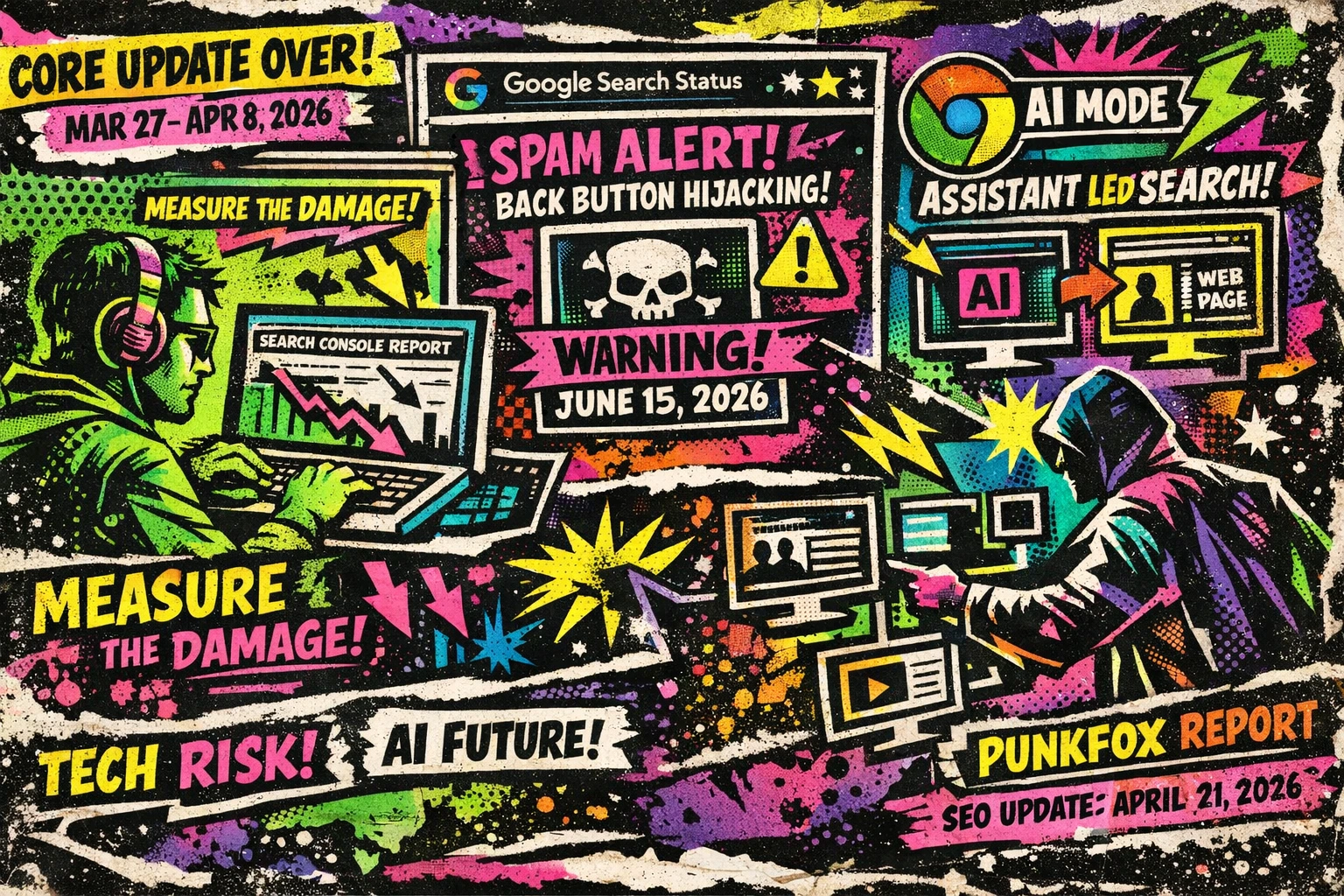
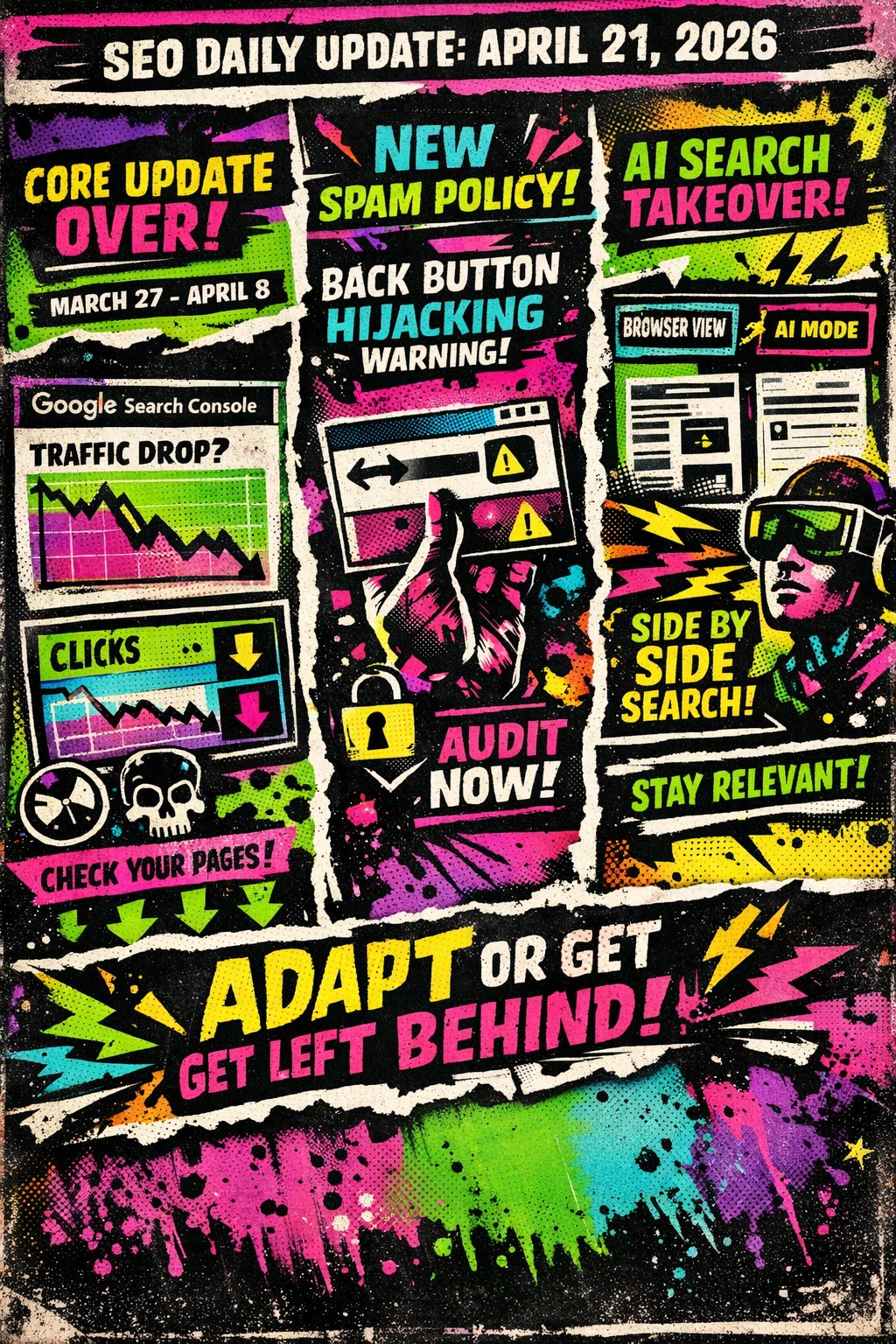
Google’s Search Status Dashboard shows that the March 2026 core update began on 27 March 2026 and was complete on 8 April 2026. That matters today because the rollout excuse has gone. If a site is still weaker now, you are no longer looking at temporary turbulence. You are looking at the new baseline Google is willing to give you.
Action:
Run a Search Console comparison for the last 7 days versus the previous 7, then compare that against the same period before 27 March. Look specifically at the pages that were your bread and butter. If those are down on impressions, clicks, or query coverage, do not wait for things to bounce back. The rollout is over. Google has likely re-evaluated how relevant your site is to the searches that used to drive your visibility.
Google has introduced a new spam policy that puts more technical setups at risk than many site owners realise.
On 13 April 2026, Google Search Central announced a new spam policy for back button hijacking, calling it an explicit violation and saying pages using it may face manual spam actions or automated demotions. Google also gave a clear enforcement date of 15 June 2026, which means this is not theoretical. It is a live warning period.
Action:
Audit any scripts, overlays, ad tech, redirect logic, or third-party libraries that interfere with browser history or trap users on-site. Even if you did not build it deliberately, Google explicitly warns that some cases can come from included libraries or advertising platforms.
AI search is getting better at keeping users inside Google’s own journey while they explore the web.
Google announced on 16 April 2026 that AI Mode in Chrome now opens clicked pages side by side with AI Mode, lets users add recent tabs, images and files into their searches, and is designed to help people go deeper without switching tabs. Right now, Google says these updates are available in the U.S., with expansion to more places coming soon. For SEO, the signal is bigger than the feature itself: Google is making the search experience more assistant-led and less dependent on the traditional click, read, back, repeat flow.
Action:
Review your key pages as if they are being consumed beside an AI assistant, not in isolation. If your page cannot communicate its value quickly, support follow-up questions, and surface the strongest evidence early, it becomes easier for Google’s AI layer to assess its usefulness while diminishing the importance of the standalone visit. That is an inference from Google’s product design direction for AI Mode in Chrome.
PunkFox Take
Google is tightening three things at once:
How it evaluates sites after a core update
What technical behaviour is it willing to penalise
How much of the search journey does it want to keep inside its own AI experience
That is why old-school SEO reporting keeps losing value. A site can finish on the wrong side of a core update, carry technical baggage that now looks spammy, and still face a search experience where Google helps users explore without leaving its own environment in the old way.
The businesses that win next will not just watch rankings.
They will measure post-update visibility properly, remove technical behaviours that create friction or distrust, and build pages that still make sense when AI sits between the searcher and the click.