Why Perth’s Construction, Legal, and Healthcare Sites Are Splitting in Two
Google confirmed that the March 2026 core update began rolling out on March 27, 2026, with a rollout window of up to two weeks. Google’s own guidance has not changed in principle: core updates reward more helpful, reliable, people-first content, and for higher-stakes topics tied to health, safety, and finances, trust signals matter even more. In local search, Google continues to prioritise relevance, distance, and prominence. That sounds tidy on paper. In Perth, it is showing up far messier in the wild.
Here’s the PunkFox read on the Monday aftermath.
This is not a story about rankings wobbling for a week and bouncing back by Friday. It is a story about eligibility. The March and early April 2026 volatility looks less like a broad slap across every site and more like a widening drift between real entities and template websites. In Western Australia, three sectors are experiencing that split faster than most: construction, legal, and healthcare.
What’s drifting apart? On one side, you’ve got businesses with strong real-world signals: actual teams, actual offices, actual jobs, actual proof, actual local reputation. On the other hand, you’ve got keyword sites dressed up as businesses: suburb page factories, AI-written explainers, vague service pages, and About sections so thin they could pass through a flyscreen. Google’s people-first guidance explicitly asks whether content shows first-hand expertise, who created it, and why it exists. When that standard gets reweighted during a core update, the gap between credible and generic gets very visible, very quickly.
Construction and Trades: The suburb page massacre
Construction and trades have been ripe for this for years. Perth electricians, plumbers, painters, roofers, and franchise-style service brands have long tried to brute-force local visibility with suburb pages that are basically photocopies with a new heading. “Plumber Balcatta.” “Plumber Scarborough.” “Plumber Morley.” Same body copy. Same testimonial style. Same stock van. Same promise to be “your trusted local experts.”
That model is ageing badly.
Google’s local systems are still built around relevance, distance, and prominence, but the interpretation is clearly getting sharper. If your site says you service every suburb from Joondalup to Rockingham, but your proof layer is weak, you are asking Google to trust a coverage claim it cannot properly verify. The businesses holding ground tend to be the ones with location proof and job proof baked into the site itself: project galleries from actual WA suburbs, references to WA building conditions and code considerations, specific service detail, and review signals that sound like real jobs completed for real locals.
PunkFox translation: Google’s local filter is acting less gullible. It does not just want a service plus a suburb combination anymore. It wants to believe you genuinely belong in that conversation.
That means the winners in construction marketing WA are not always the biggest operators. Often, they are the sharper boutique builders, specialist contractors, and trade businesses that can prove they exist beyond the template. A gallery from a renovation in Dalkeith, a note about council-specific constraints, a testimonial that names the kind of job done, and a properly maintained Google Business Profile can do more than fifty cloned location pages pretending to be local.
Legal services: The expertise tax has arrived
Law has a different problem. Generic legal content used to be tolerable because it was useful enough to capture early-stage search intent. Now it is dangerously summarisable.
Google says it wants original information, reporting, research, or analysis. It also says that for topics that can affect a person’s financial stability, safety, or well-being, trust is weighed more heavily. Legal content lives inside that higher-stakes zone. So if a Perth law firm is publishing bland articles like “What is a will?” or “How does family mediation work?” with no WA framing, no practitioner authorship, no legislative context, and no insight a machine cannot paraphrase, it is begging to be outranked, absorbed, or bypassed.
This is where the expertise tax kicks in. If your legal advice reads like a cleaned-up encyclopedia page, Google has no reason to reward it as premium. It can be replaced by an overview, a summary, or a more authoritative competitor with actual interpretation.
The firms with upside here are not just “doing SEO for lawyers Perth.” They are publishing information gained. That means WA-specific legislative updates, commentary on practical implications, matter-specific explainers tied to what clients in this state actually face, and author pages that make it obvious who is speaking and why they should be trusted. Google’s guidance on content authorship is not cosmetic. It asks whether readers can clearly identify who created the content and whether that author has a background in the area they write about. In legal, that is no longer optional window dressing. It is part of the trust stack.
Using a Semrush snapshot I pulled today for Australia, “SEO for lawyers Perth” shows measurable demand at around 70 monthly searches, which is not huge in raw volume but is highly commercial. That matters. A smaller search volume does not make the opportunity smaller. It makes weak content more obvious.
Healthcare and medical: Trust architecture is now the job
Healthcare SEO is where this drift gets most serious.
Google’s documentation is explicit that trust matters most, and that systems give more weight to strong E-E-A-T alignment on YMYL topics, including health. In plain English, Google is not just ranking a clinic website. It is deciding whether to place a provider in front of a worried person at a vulnerable moment.
That is why thin clinic sites are bleeding quietly. Not exploding. Bleeding.
The slow losers tend to look similar: vague About pages, no meaningful practitioner profiles, generic symptom pages, minimal review integration, recycled stock imagery, and no visible connection between the website and the real people delivering care. These sites may still rank for their brand. They may still hold some legacy visibility. But they start losing the searches that matter most commercially, especially those near the edge of trust where patients are comparing providers, not just looking for a definition.
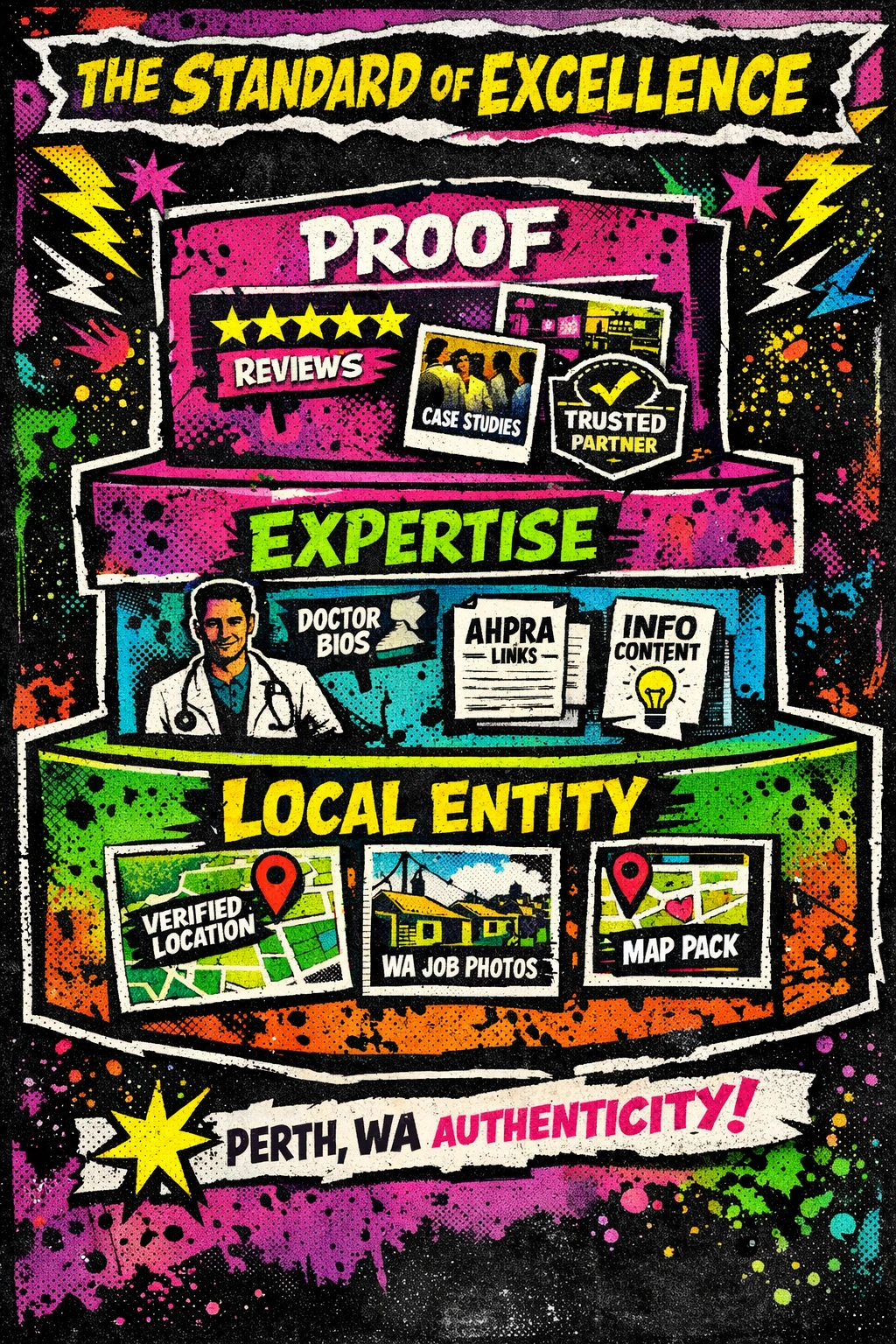
The sites gaining ground are building trust architecture, not just content volume. They show doctors and allied health practitioners properly. They link credentials clearly. They reference professional associations where appropriate. They publish content that speaks to patient anxiety, treatment expectations, recovery timelines, and the real questions patients ask before they book. That is not fluff. That is the difference between symptom stuffing and credible care communication.
Semrush data supports the commercial weight here, too. “Healthcare SEO” is sitting at roughly 320 monthly searches in Australia with a strong CPC, which tells you the market already values this category. The businesses that treat trust as a design system, not a compliance chore, are the ones best placed to benefit.
The Monday aftermath checklist
If you are a WA business owner looking at Search Console this morning, do not start with panic. Start with pattern recognition.
First, check for ghost impressions. If branded queries are steady but service plus suburb terms are sagging, you may still be visible without being truly competitive. That is the first warning sign of drift.
Second, run the AI overlap test. Take the best paragraph from your key service page or blog article and drop it into Gemini. If the tool can reproduce the same value, in the same shape, in seconds, your page probably is not adding enough original substance. Google’s own self-assessment questions ask whether your content provides original information, reporting, research, or analysis. If the answer is “not really,” you have work to do.
Third, audit the proof layer. Does your site show your actual Perth office, your actual team, your actual projects, and your actual WA context? Or is it a sea of generic claims and stock photography? Google’s local guidance makes it plain that complete, detailed business information helps local visibility, and prominence is influenced by signals like reviews and broader web reputation.
What the graph should show
The visual story here is simple.
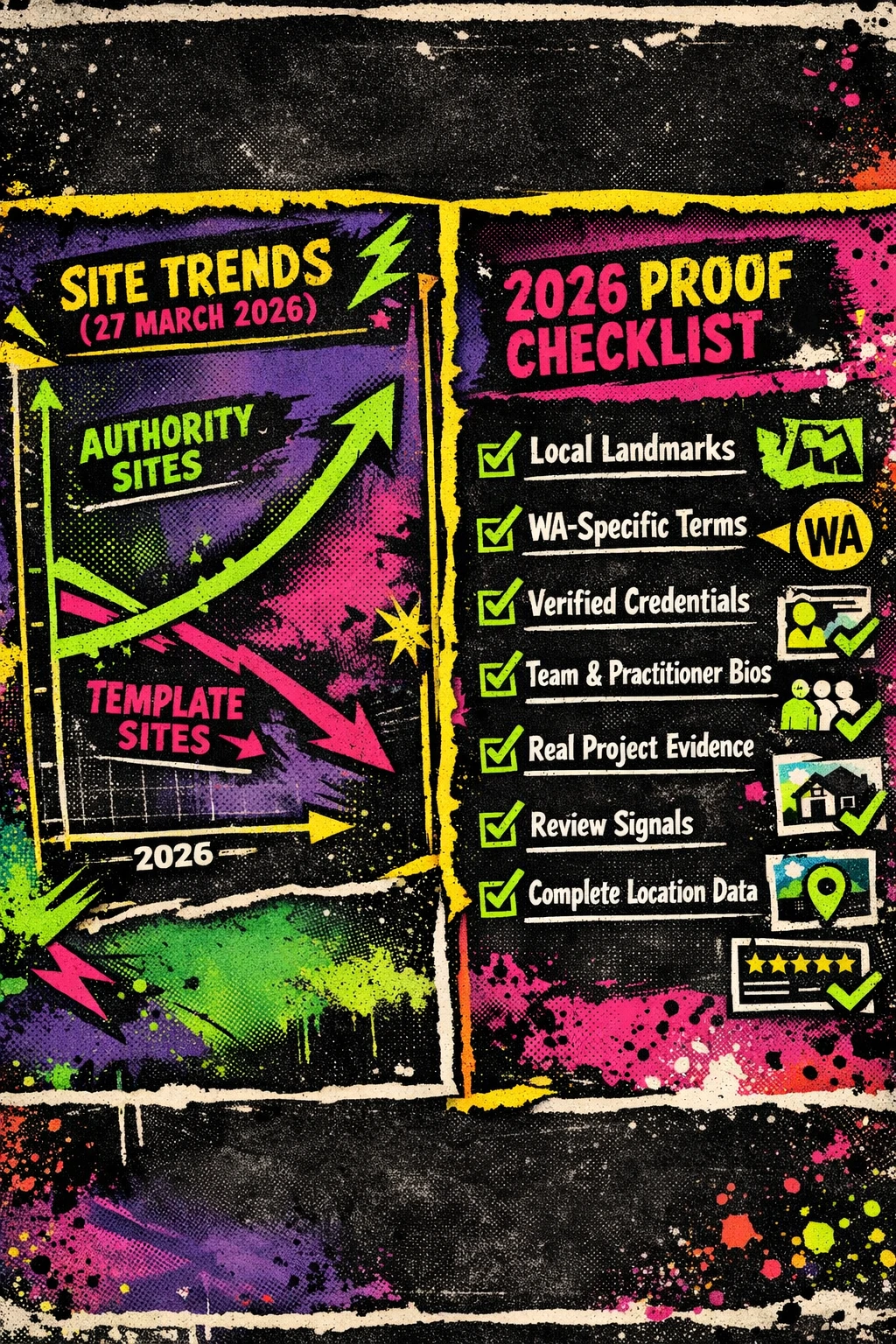
Picture a line chart starting on 27 March 2026. One line is “Authority Sites.” The other is “Template Sites.” The authority line bends upward as the rollout progresses. The template line slopes down. That is the drift.
Then pair it with a second visual, a proof checklist for 2026: local landmarks, WA-specific terminology, verified credentials, practitioner or team bios, real project evidence, review signals, and complete location data. Not because Google wants pretty branding. Because it wants enough evidence to trust the recommendation.
The real takeaway
The Monday aftermath is not about a drop in rankings. It is about a shift in eligibility.
If your site is drifting into the template trap, the fix is not another batch of pages. It is a rebuild of trust architecture, proof, and information gain.
That is the split happening in Perth right now.
And if your sector is feeling it, this is the moment to measure the gap before your competitors widen it for you.
Ben Murphy is an SEO specialist with over 15 years of hands-on experience helping businesses grow through transparent, data-driven search strategies, having launched and scaled one of Manchester’s leading SEO agencies before relocating to Perth in 2025 to bring his proven methodology to the Australian market. Known for long-term client retention, measurable results, and a partnership-first approach, Ben now leads PunkFox with a focus on delivering senior-level expertise, honest guidance, and sustainable organic growth for brands across Perth and beyond.