Why Ranking #1 in the Map Pack No Longer Guarantees Traffic
By Ben Murphy
For years, local SEO had a simple promise.
Get into the Map Pack.
Push to position one.
Collect the clicks.
That worked when Google behaved like a directory, whereas it now behaves more like a recommender, and this is a difference that matters as the Map Pack is no longer the first decision layer.
In a growing number of local searches, Google is starting to frame the answer before the user ever reaches the listings. By the time the Map Pack appears, the user is no longer deciding from scratch. They are validating what Google has already implied.
That means a business can still rank well locally and lose the click anyway.
The Map Pack Is Not the Goal Anymore
This is the part that most agencies have not yet caught up with.
They are still selling local SEO like it is 2019. Get the listing right. Collect more reviews. Add a few suburb pages. Climb the pack.
This approach isn’t useless. It is just not enough anymore.
The problem is that Google is inserting a new layer above the listings. Instead of simply presenting three businesses and letting the user choose, it is increasingly summarising, comparing, and framing the options first. That changes the entire search journey.
The Map Pack used to be the decision point. Now it is becoming the confirmation layer.
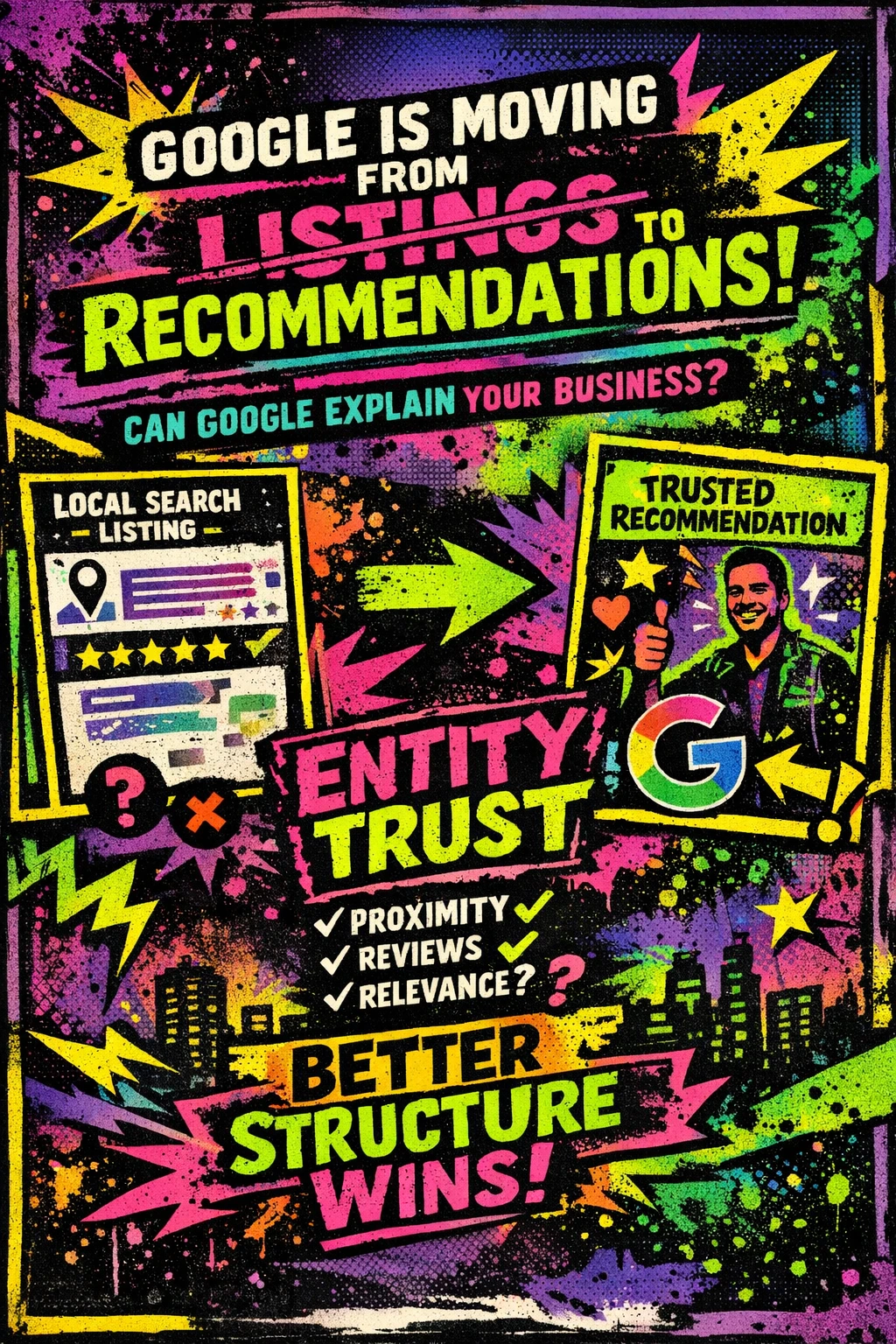
Google Is Moving From Listings to Recommendations
That is the real shift.
Local search used to be driven by visibility. Show up, look legitimate, get clicked.
Now it is being driven by explainability, which is why stronger GEO strategies are becoming critical for businesses that want to be included in AI-driven recommendations.. Google wants to feel confident enough to explain why one business makes more sense than another. That is a very different standard.
A listing can rank because it is nearby. A business gets recommended because Google understands it.
That is why local SEO is starting to feel less predictable. Proximity still matters. Reviews still matter. Relevance still matters. But those signals are being layered with something more structural.
Entity trust.
The New Local SEO Question
The old question was: Can Google find your business?
The new question is: Can Google explain your business?
Those are not the same thing.
A business with a decent listing, average reviews, and a basic website might still appear in local results. But if its service pages are vague, its positioning is inconsistent, and its business information does not line up across the web, Google has a trust problem.
And when Google has a trust problem, it hesitates. That hesitation is the gap where better-structured competitors win.
Why Proximity Is Starting to Decay
Local SEO advice used to be built on a simple formula. Be close. Be relevant. Get reviews.
That formula is weakening.
A business 2km away with weak entity trust can now lose to a business 5km away that Google can actually verify and explain. That is the shift nobody wants to admit because it breaks the lazy version of local SEO.
Distance still influences visibility. It just no longer guarantees preference.
Google is getting better at recognising which businesses feel complete, consistent, and trustworthy across the ecosystem. When that happens, the closest option is not always the safest option.
This Is Why Rankings Can Stay Stable While Traffic Falls
This is where business owners get blindsided.
They check rankings. Nothing dramatic has changed. The Map Pack position looks stable. The listing still appears.
But traffic drops. Calls soften. Clicks slip.
That does not feel logical until you understand what is happening above the listings.
Google is answering more of the local queries before the user clicks. It is shaping the perception of the market before the user compares businesses manually. So even if your position does not move, the amount of attention reaching your position can shrink.
That is not a ranking problem. It is a pre-click bias problem.
Google is not just organising the options anymore. It is nudging the decision.
Most Local SEO Content Is Too Weak to Survive This Shift
This is another uncomfortable truth.
Most local business websites are not built to be understood. They are built to exist.
They have service pages that say the same thing as every other competitor. They have location pages that change only the suburb name. They have broad claims, safe wording, and nothing memorable enough to help Google summarise them confidently.
That kind of content used to be enough to support a listing. It is not enough to support a recommendation.
Google would rather recommend a specific, verified insight from a forum post than a polished, generic service page that says nothing. If your site sounds less real than a local discussion thread, you are failing the explainability test.
What Entity Trust Actually Looks Like
Entity trust is not some mystical SEO buzzword. It is the practical outcome of alignment.
Your website says one thing.
Your Google Business Profile says the same thing.
Your service areas are consistent.
Your offers are clear.
Your reviews reinforce the positioning.
Your external mentions do not contradict the story.
That is how a digital entity becomes trustworthy.
A mismatch does the opposite.
Google’s AI is a consistency engine. If your website says “Perth Wide” but your GBP is locked to a 20km radius in Joondalup, you have not optimised for a suburb. You have created a data contradiction that lowers your entity trust score.
If your listing implies 24/7 emergency response but your website reads like a 9-to-5 office, Google sees uncertainty. If your reviews describe a niche speciality but your service pages stay generic, Google loses confidence in how to categorise you.
This is no longer a citation cleanup issue. It is a trust architecture issue.
What Local SEO Looks Like Now
The businesses that win next will not be the ones with the most superb pages or the neatest keyword mapping.
They will be the ones Google understands fastest.
That means local SEO now needs to do more than optimise a listing. It needs to build an entity that holds together across every visible surface.
Your site needs sharper service positioning.
Your profile needs consistency.
Your content needs local specificity.
Your proof needs to support your claims.
This is exactly why SEO strategies for Perth businesses can no longer rely on broad location targeting and polished filler. A generic local page might still get indexed. That does not mean it will earn attention.
The Real Goal Has Changed
Ranking in the Map Pack used to be the goal. Now it is just one checkpoint.
The real goal is to become the business Google feels confident enough to explain before the user starts comparing options. That is a harder standard, but it is also where the market is heading.
Most agencies are still chasing pins on a map. We are building digital entities that Google is willing to vouch for.
That is the difference.
What To Do Next
Start with a brutal audit of your local signals.
Can Google clearly understand what you do, where you do it, and why your business should be chosen over another one nearby?
Does your website reinforce your Google Business Profile, or quietly undermine it?
Do your service pages sound specific enough to be recommended, or generic enough to be replaced?
That is the level local SEO is operating at now.
A free SEO audit is the fastest way to see where your local entity is holding together and where it is quietly leaking trust.
Ben Murphy is an SEO specialist with over 15 years of hands-on experience helping businesses grow through transparent, data-driven search strategies, having launched and scaled one of Manchester’s leading SEO agencies before relocating to Perth in 2025 to bring his proven methodology to the Australian market. Known for long-term client retention, measurable results, and a partnership-first approach, Ben now leads PunkFox with a focus on delivering senior-level expertise, honest guidance, and sustainable organic growth for brands across Perth and beyond.