Published on May 20, 2026
SEO Daily Update: May 20, 2026
By Ben Murphy
Google Is Drawing A Harder Line Between Real AI SEO And Shortcuts
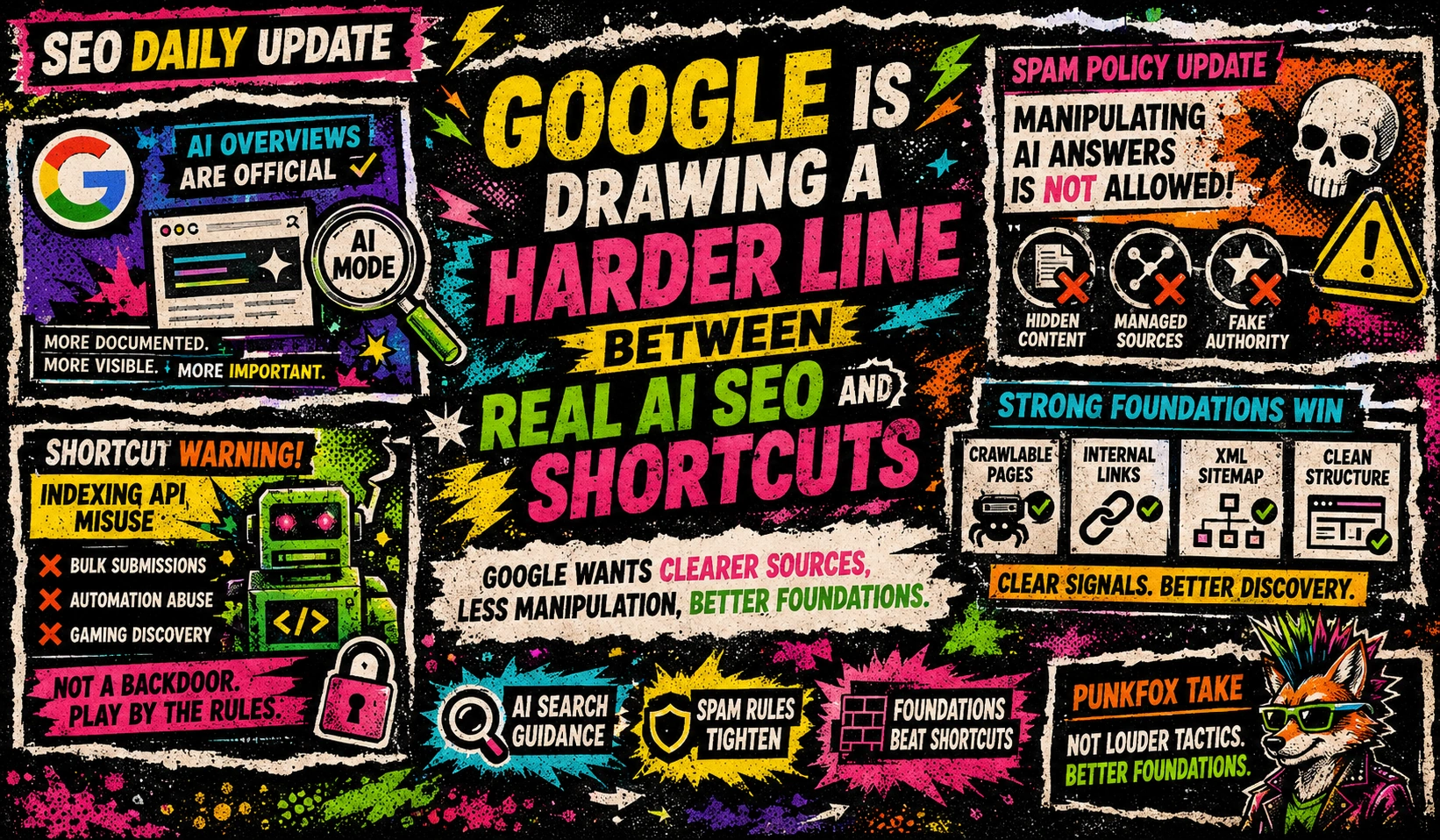
Today’s strongest SEO developments all point in the same direction. Google is making AI search more official, more documented, and more tightly controlled at the same time. The clearest signal is Google publishing new Search Central guidance for generative AI in Search, followed by an explicit spam-policy update covering attempts to manipulate AI Overviews and AI Mode, while John Mueller’s warning about Indexing API misuse reinforces that technical shortcuts are still not a substitute for solid SEO foundations.
Google has published its clearest guidance yet on how to appear in AI search.
Google’s new Search Central documentation explains how site owners can improve visibility in AI Overviews and AI Mode. The important part is that it does not introduce a magical new optimisation trick. Instead, it reinforces the same things Google has wanted for years: content that is useful, clear, trustworthy, and easy to cite with confidence.
That matters because it removes a lot of AI SEO noise. Businesses do not need a separate “secret” AI strategy nearly as much as they need content and site signals that Google already sees as strong enough to surface, summarise, and trust.
Action:
Review your most important commercial and informational pages as if they need to be cited, not just ranked. Tighten clarity, improve evidence, make expertise more obvious, and remove anything vague enough to be ignored when Google looks for a source it can trust.
Google now explicitly treats manipulation of AI answers as spam.
Google has updated its spam policies so that attempts to manipulate AI-generated responses in Search, including AI Overviews and AI Mode, are explicitly covered. That is one of the clearest official lines yet between legitimate AI SEO and tactics designed to game generative results.
This matters because it changes the conversation around GEO and AI visibility. If the strategy depends on forcing mentions, inflating signals, or engineering artificial recommendation paths, the risk is now much more obvious. Google is effectively saying that if a page deserves to be cited, it should earn that position through usefulness and trust, not system manipulation.
Action:
Cut any AI-search tactic that sounds clever but would be embarrassing to explain plainly to a client. If it relies on manipulation rather than authority, it is on the wrong side of the line. Build content and brand signals that deserve to be referenced instead.
John Mueller’s Indexing API warning is a reminder that shortcuts still do not beat fundamentals.
John Mueller has warned that bloggers and SEOs are overusing Google’s Indexing API outside its intended purpose. The API was designed for narrow use cases like job postings and live streams, not as a general indexing shortcut for normal site content.
That matters because it is the same lesson in another form. Even as Google expands AI search, it is still telling people not to rely on unsupported workarounds. Sites that want stronger visibility need good crawlability, sensible internal linking, strong content, and a clear site structure. That has not changed.
Action:
Stop looking for indexing cheats if the underlying site is weak. Focus on crawl paths, internal linking, XML sitemaps, template quality, and pages that genuinely deserve to be discovered. If Google is not indexing your new pages, it is rarely because you did not push them hard enough. It is usually because the site is wasting crawl budget through bloated loops, broken redirect paths, or messy canonicals. The boring technical foundations still do more work than the shortcut culture ever will.
Website search interface showing AI Overviews, stricter spam rules, and technical SEO fundamentals becoming more important as Google defines the rules of AI visibility.
PunkFox Take
The AI search conversation is getting more useful.
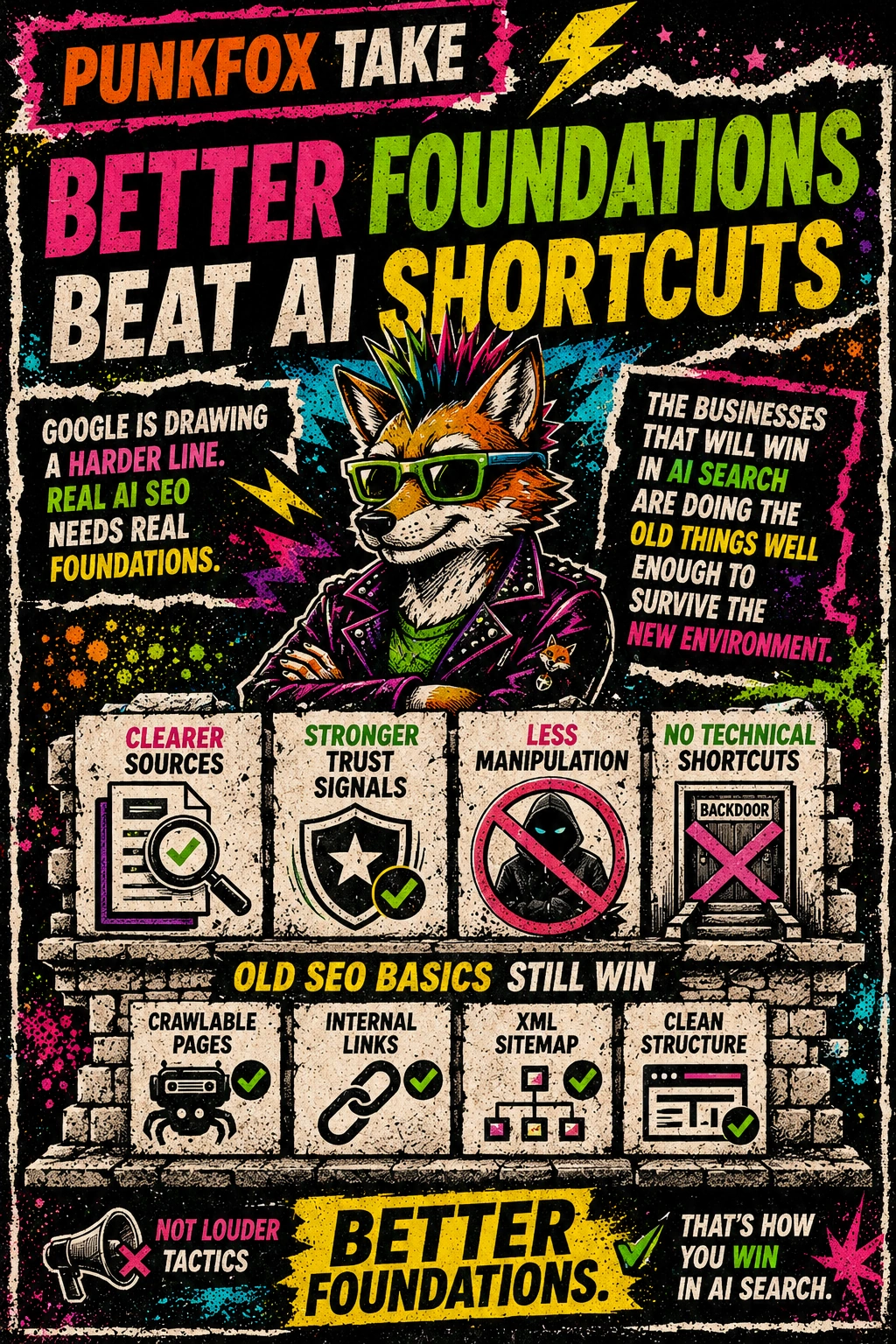
Google wants clearer sources, stronger trust signals, less manipulation, and fewer technical shortcuts pretending to be strategy.
This means the businesses most likely to do well in AI search will usually be the ones doing the old things well enough to survive the new environment.
Not louder tactics. Better foundations.