Published on June 10, 2026
SEO Daily Update: June 10, 2026
By Ben Murphy
Google Is Making Visibility Harder To Fake And Harder To Measure
The last few days have made one thing pretty obvious.
Google is not just moving rankings around again. It is making visibility harder to manufacture, while also making the old ways of measuring SEO less useful.
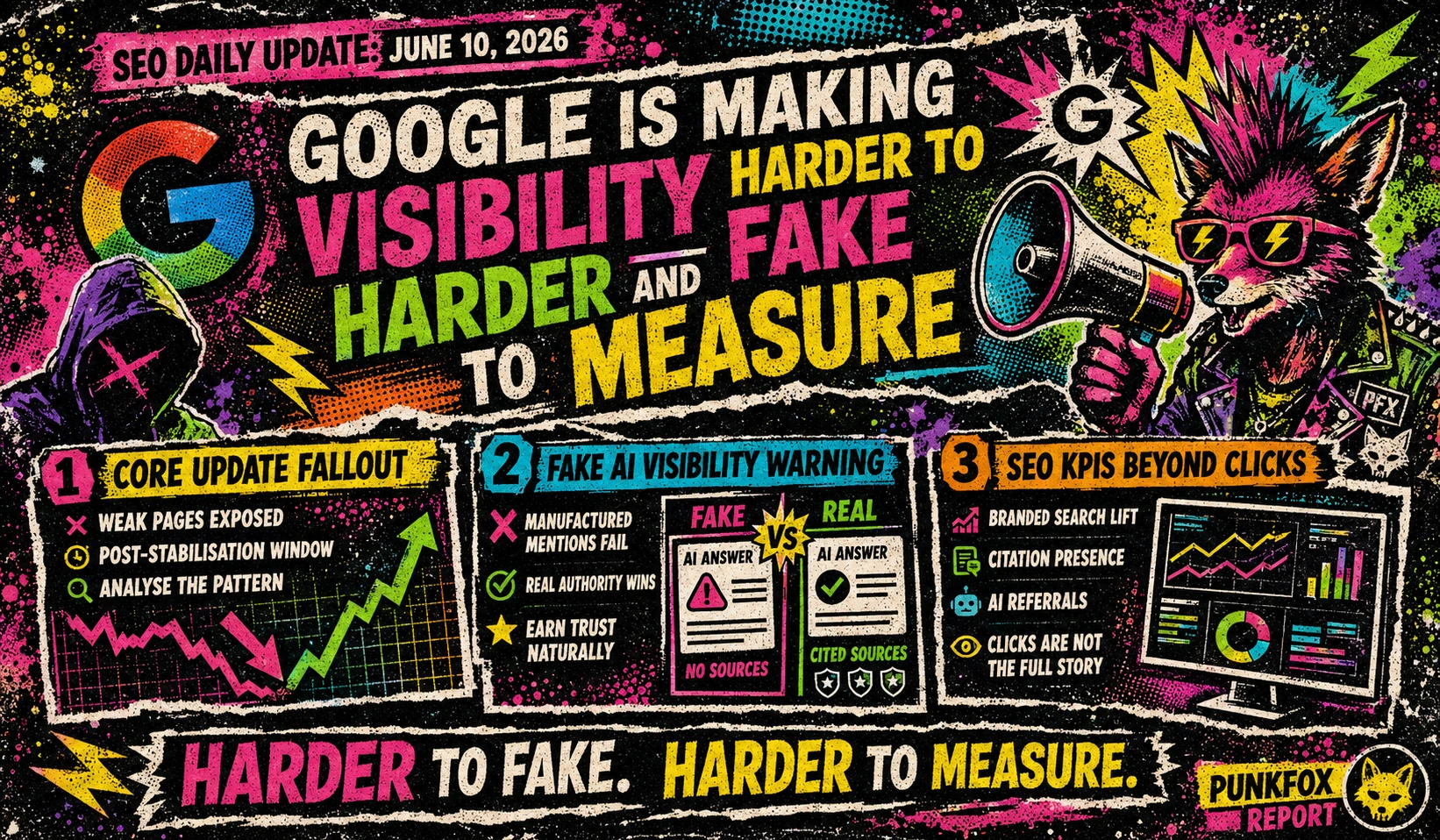
The clearest signs are the May 2026 core update fallout, Google’s stronger warning against manipulating brand mentions for AI, and a growing shift away from clicks as the main way SEO success gets judged.
That is not a small change.
It means weak pages are easier to expose, fake authority is easier to discount, and lazy reporting is getting easier to outgrow.
The May core update is still doing what core updates always do. Exposing what was weaker than people thought.
Google’s May 2026 core update started rolling out on 21 May. Over the weekend, Barry Schwartz reported that it appeared to hit some sites especially hard on 30 May, with multiple tracking tools and SEO chatter showing stronger turbulence.
The rollout officially wrapped up on 2 June, which means we are now in the critical post-stabilisation window where the real permanent damage or gains can be analysed more cleanly.
That matters because core updates are where “good enough” SEO usually gets found out.
Pages that have survived on age, habit, thin optimisation, or lack of competition can suddenly look a lot weaker when Google starts asking harder questions. Weak service pages, low-differentiation category pages, and copy that says plenty without proving much are usually where the damage shows first.
Action:
Treat the current movement as an analysis window, not a panic window. Split branded from non-branded shifts. Compare page types. Look at which sections were hit first. That pattern usually tells you far more than the headline drop.
Google is drawing a harder line around fake AI visibility.
Barry Schwartz also reported that Google is strongly warning against manipulating mentions for AI. That matters because a lot of businesses are still treating AI visibility like a loophole instead of a trust problem.
That is the wrong read.
If the strategy depends on synthetic brand mentions, inflated recommendation signals, or coverage that would never exist naturally, then it is not authoritative. It is a theatre. Google is getting better at ignoring that sort of thing and is more comfortable telling people where the line is.
The businesses that do well in AI-led search are still the ones that look worth citing. Clear positioning. Strong evidence. Useful pages. Real expertise. Recognisable brand signals. The old fundamentals still do the heavy lifting. Google is just making the shortcut culture look thinner than ever.
Action:
Cut anything that depends on manufactured credibility. If the brand does not earn mention naturally through expertise, coverage, or usefulness, it is not a strategy worth building on.
SEO reporting is starting to miss too much if it still revolves around clicks alone.
Search Engine Land’s recent guide on new SEO KPIs beyond clicks makes a point that more businesses need to hear. Rankings, impressions, and clicks still matter, but they do not explain enough on their own anymore.
Not in a search environment shaped by AI answers, zero-click behaviour, richer search interfaces, and more pre-click decision-making.
A business can still be discovered, still influence the decision, and still build demand without the old traffic graph telling the full story. That is why relying on sessions alone is becoming a lazy way to judge SEO.
The more useful signals now are the ones that show whether visibility is actually strengthening:
Branded search growth
AI-driven referrals, where tracking allows
Self-reported attribution data
Third-party source and citation presence
Whether AI systems use your brand as part of the answer, not just whether a user clicked a link
Action:
Widen the scoreboard. Track branded search lift. Add self-reported attribution to high-intent forms. Watch for AI-source referrals where possible. Stop treating traffic alone as the whole definition of SEO success.
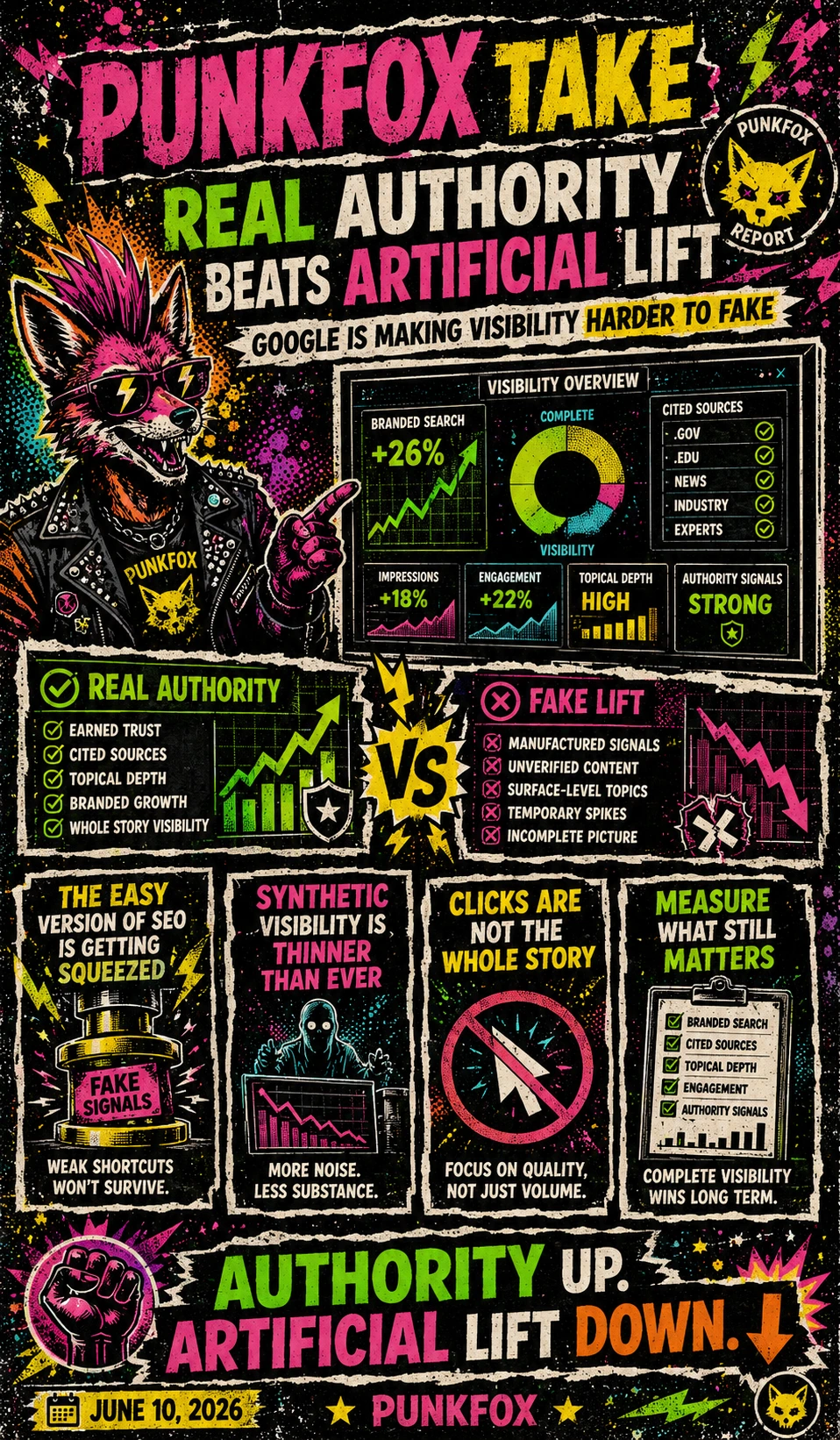
PunkFox Take
The easy version of SEO is getting squeezed.
Google is still moving the rankings around, but it is also making synthetic visibility less reliable and old reporting habits less useful.
That means the next edge is not just “better SEO”.
It is knowing the difference between real authority and artificial lift, then being able to measure the parts of visibility that still matter when the click is no longer the whole story.