Published on July 2, 2026
SEO Daily Update: July 2, 2026
By Ben Murphy
AI Search Is Getting Better At Ignoring Brands That Only Sound Relevant
The last two weeks have made one thing pretty obvious.
AI visibility is getting harder to fake.
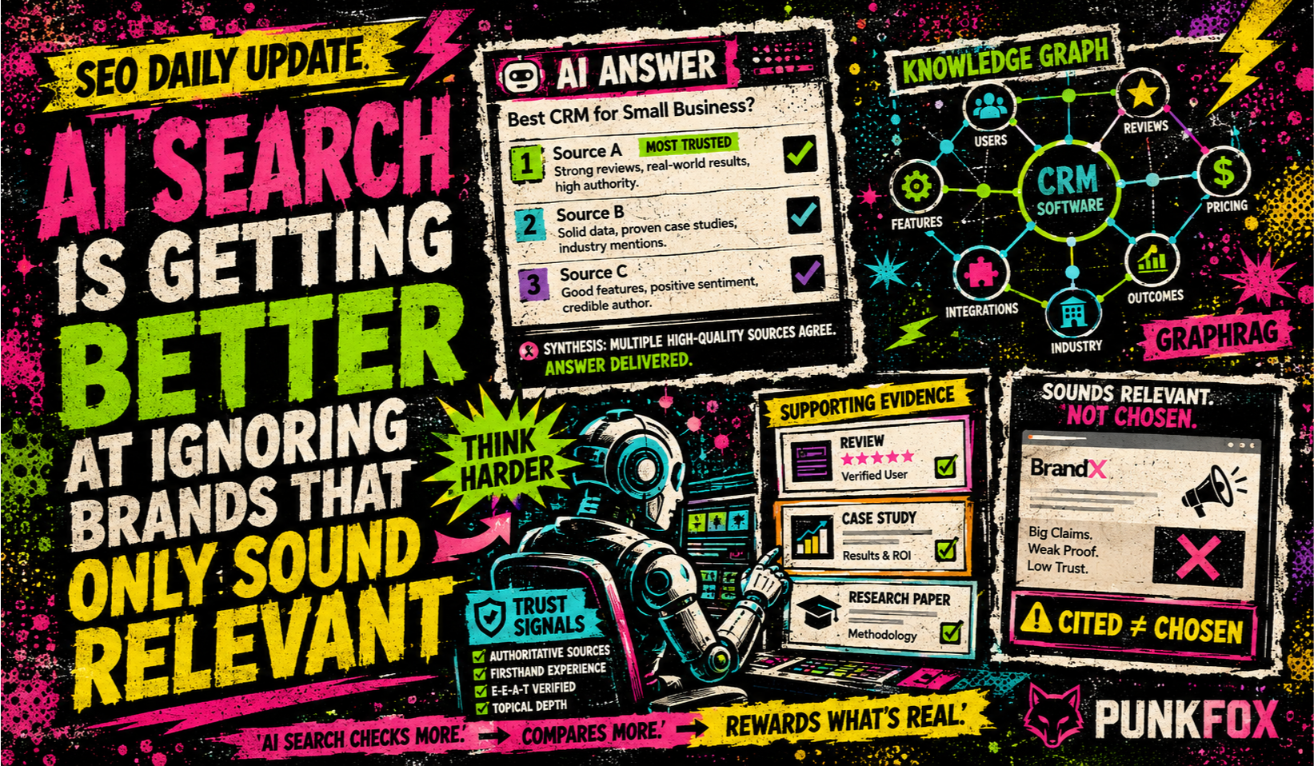
Recent analysis shows that ChatGPT Thinking mode changes which brands get cited, that GraphRAG is pushing retrieval toward entities and relationships rather than flat text, and that Google AI Overviews will happily cite a brand’s own “best” page while still recommending someone else. Put simply, search is getting better at telling the difference between content that sounds relevant and brands that actually look trustworthy.
ChatGPT’s deeper reasoning is changing who gets cited.
One of the clearest updates in this window is the July 1 analysis of ChatGPT Thinking mode. Semrush and Kevin Indig found that only 25.6% of cited domains overlapped between minimal and high-reasoning mode for the same prompts, and the higher-reasoning version ran nearly five times as many web searches. That is not a small shift. It means the “easy” version of AI visibility and the harder, more checked version are already behaving like different search surfaces.
That matters because a brand can look visible in the light version of the answer and disappear the moment the query gets harder. If a model is checking more, searching more, and pulling from a wider source set, thin pages and vague claims get exposed faster. The pages that hold up tend to be the ones with stronger evidence, clearer explanations, and content that still makes sense when the system stops taking the page at face value.
Action:
Review the pages that would need to survive a harder question, not just an easy one. Support pages, documentation, comparison content, and evidence-backed explanations are starting to matter more because AI systems are doing more of the checking before they decide what to cite.
AI retrieval is moving toward connected entities, not isolated pages.
The July 1 GraphRAG piece is one of the most useful technical updates in this period because it explains what a lot of brands are getting wrong. GraphRAG extends traditional retrieval-augmented generation with a knowledge graph that helps AI understand entities and the relationships between them. In plain English, machines are getting better at following the lines between your business, your people, your certifications, your services, and the proof behind them.
This is where a lot of businesses get exposed. They may know their subject, but the site is still hard to interpret. Expertise is buried. Service pages talk in circles. Trust signals sit in the wrong places. The business might rank somewhere, but it is much harder for machines to understand cleanly enough to surface with confidence. And when a system has to guess, the point is blunt: the safe move is to leave your brand out.
Action:
Make the business easier to explain without guesswork. Tighten service pages, connect expertise to real people and real proof, improve structured data where it actually clarifies meaning, and stop leaving your strongest authority signals disconnected from the pages that need them most.
Google is happy to quote your page and still recommend somebody else.
Lily Ray’s June 18 study is the cleanest reality check in the whole period. Across 100 B2B “best [category] software” queries, self-promotional listicles were cited 323 times inside AI Overviews. But in 224 of those cases, Google cited the brand’s own page and still did not recommend that brand. Citation is not endorsement. Being mentioned is not the same as being chosen.
That matters because a lot of SEO and GEO work is still built on the wrong assumption. Brands think that if they publish the “best” page, Google will take their word for it. It will not. Google might use the page as a source, then hand the recommendation to someone with stronger trust signals, clearer authority, better brand recognition, or better independent proof. That is the gap a lot of businesses are still missing.
Action:
Stop treating self-promotional “best” pages as a moat. If you want stronger AI visibility, build independent proof around the brand. Better reviews. Better coverage. Better third-party trust. Better pages that still hold up when the system is not taking your word for it.
Website search interface showing AI systems comparing sources, following entity relationships, and favouring stronger trust signals over self-promotional positioning.
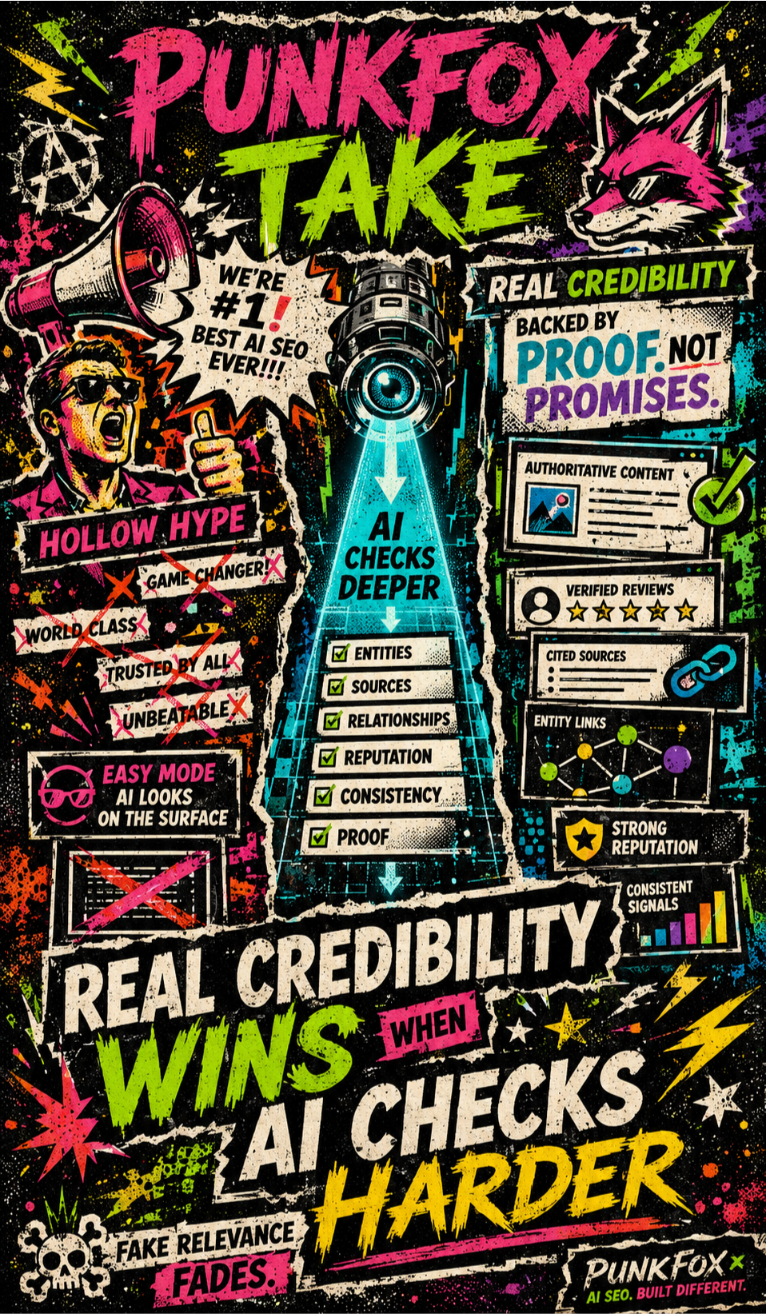
PunkFox Take
The easy version of AI SEO is getting weaker.
Machines are getting better at ignoring brands that only talk themselves up.
They are leaning harder on structure, relationships, documentation, and independent trust. That means the brands most likely to win are not the ones shouting the loudest. They are the ones that still look credible when the query gets harder, the reasoning gets deeper, and the system stops taking the page at face value.