Published on April 22, 2026
SEO Daily Update: April 22, 2026
By Ben Murphy
SEO Is Becoming More About Retrieval Than Ranking
Today’s strongest SEO developments all point in the same direction. Search is becoming less about whether a page ranks for one obvious keyword and more about whether content can be found, entered, expanded, and reused across multiple search environments. The clearest signal is Google’s new guidance for Read More deep links, but the wider industry push around query fan-out and GEO playbooks shows the same shift from a different angle.
Google is getting clearer about how it wants to enter your page.
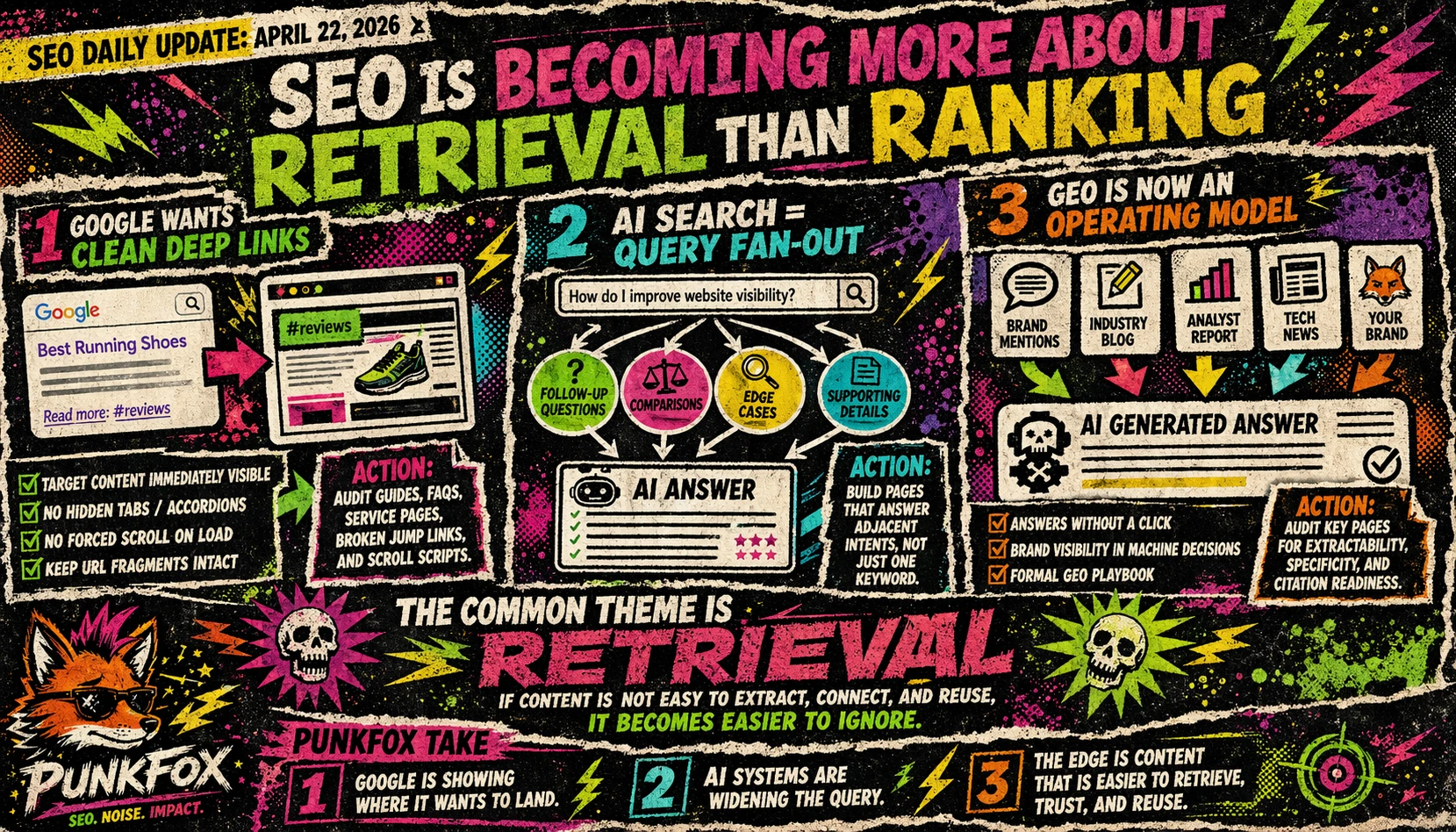
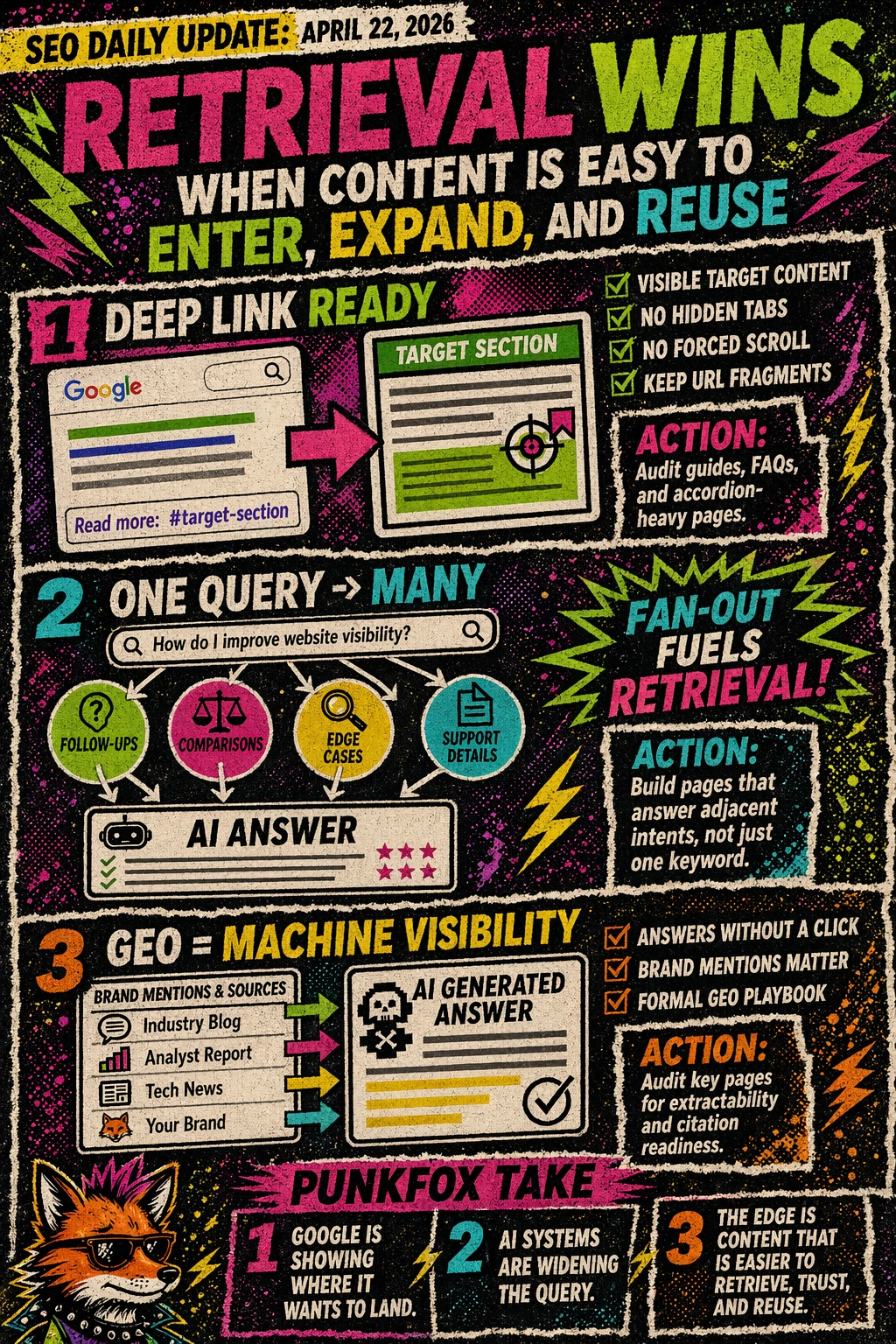
Google has now documented best practices for Read more snippet links. The guidance says the target content should be immediately visible, not hidden behind tabs or expandable elements, JavaScript should not force scrolling on page load, and sites should not remove the URL fragments that support deep linking. That matters because Google is not just deciding whether your page is relevant. It is deciding whether it can confidently send users straight to the right section.
Action:
Review guides, long-form service pages, FAQ templates, and resources for accordion-heavy layouts, broken jump links, and scroll-manipulating scripts. If Google cannot reliably land users in the right place, your content is harder to surface cleanly in richer search results.
AI search is making one query behave like many queries.
Search Engine Land published three fresh pieces yesterday on query fan-out, explaining how AI search systems can take a single user query and expand it into multiple hidden sub-queries, comparisons, and supporting angles before forming an answer. That changes the optimisation challenge. A page no longer competes only on the exact phrase typed into the box. It increasingly competes on whether it covers the surrounding intents that AI systems pull in behind the scenes.
Action:
Stop judging content solely by whether it targets a single main keyword cleanly. Look at whether your best pages answer the follow-up questions, edge cases, comparisons, and supporting details that an AI system is likely to retrieve when expanding the original search.
GEO is becoming an operating model, not a side experiment.
Search Engine Land also reported yesterday on IBM’s position that brands now need a formal GEO playbook because AI systems are increasingly answering questions, comparing options, and recommending brands without sending users to a website first. That matters because it shifts the job of SEO again. It is not only about earning traffic. It is also about making sure your brand is visible in machine-made decisions.
This is what makes today’s updates fit together. Google is refining how it links into pages, AI systems are expanding how they interpret queries, and large brands are being told to treat answer-engine visibility as a process that needs structure, not guesswork. The common theme is retrieval. If your content is not easy to extract, connect, and reuse, it becomes easier to ignore.
Action:
Audit your key commercial pages for extractability. Make sure they are easy to deep-link into, clear enough to answer related sub-questions, and specific enough that an AI system can understand when to cite or recommend them. Generic pages are getting easier to bypass.
Website structure visual showing Google deep links, hidden fan-out queries, and brand mentions being pulled into AI-generated search answers.
PunkFox Take
SEO used to be mostly about proving relevance.
Now it is also about proving usability to machines.
Google is showing where it wants to land.
AI systems are showing how they widen the query.
And brands are being told to treat machine visibility as a real operating discipline.
That means the next edge is not just better rankings.
It is content that is easier to retrieve, easier to trust, and easier to reuse.