Published on April 10, 2026
SEO Daily Update: April 10, 2026
By Ben Murphy
More content might be the reason your SEO is getting weaker.
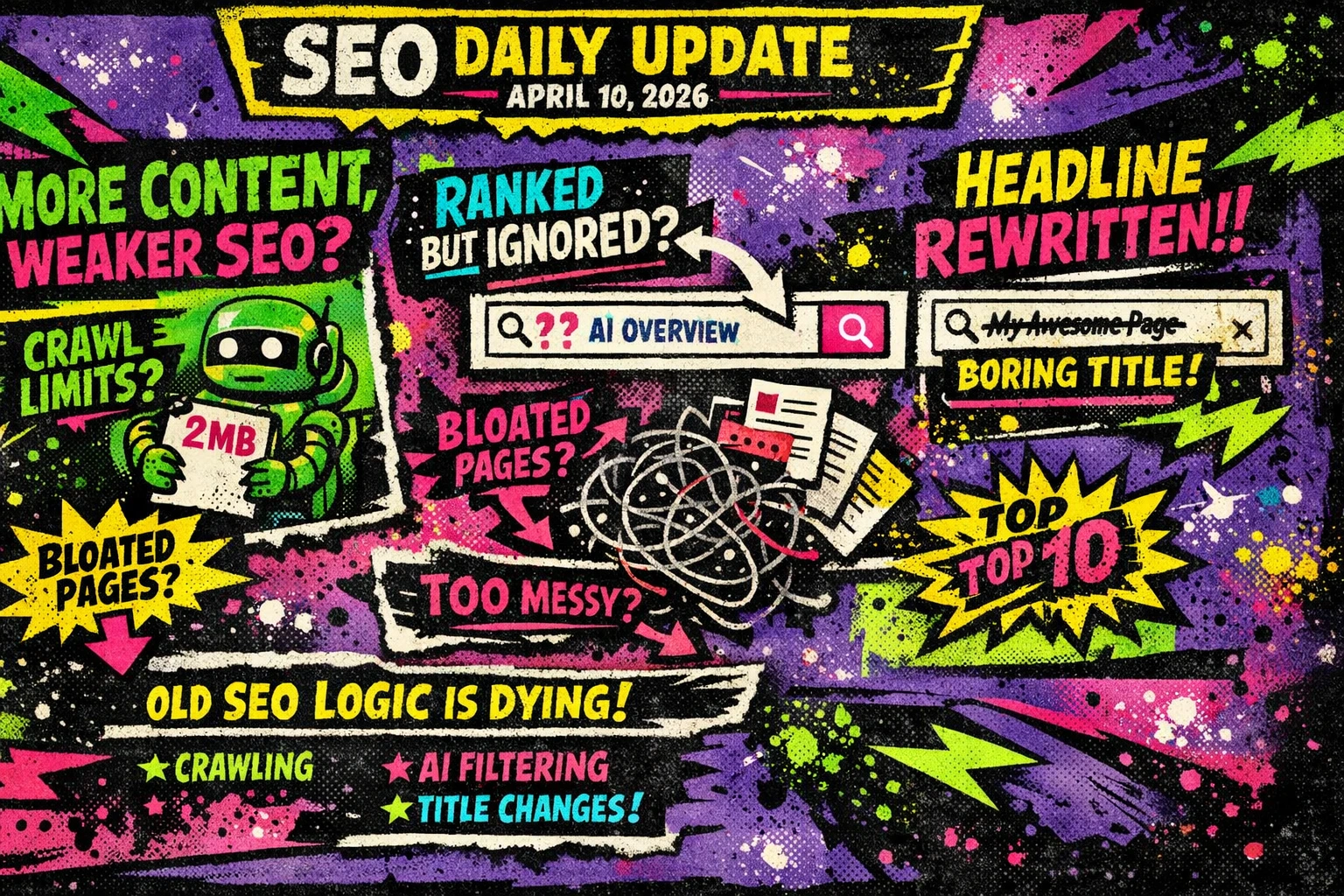
The March 2026 core update is now complete, which means the “wait and see” phase is over and the comparison phase begins. At the same time, Google has clarified more about how crawling works, including the reality that Googlebot can stop fetching after roughly 2MB and still pass truncated content to indexing as if it were complete. In plain English, bigger sites do not automatically get an advantage. In some cases, they are creating more crawl friction, more processing waste, and more weak pages for Google to reassess.
Action:
Do not assume publishing more pages is helping. Check whether your secondary templates, long-tail pages, and bloated layouts are actually diluting visibility. If your site keeps expanding while impressions keep narrowing, Google may be reading that as sprawl, not strength.
Ranking in the top 10 does not mean Google wants to use your content.
Fresh industry analysis keeps reinforcing the same point: top rankings do not guarantee inclusion in AI Overviews. Google’s AI layer is not just looking for “the page with the strongest SEO signals.” It is looking for the cleanest, most usable answer. That means a page can rank well, yet still be ignored by the part of Google that is increasingly shaping clicks, summaries, and visibility.
Action:
Review your most important pages and ask a harder question than “Does this rank?” Ask: “Can this be extracted cleanly?” If the answer is no, your content may be too vague, too padded, or too structurally messy to survive answer-first search.
Google is also getting more comfortable rewriting how your content is presented.
Google has confirmed it is testing AI-generated headline rewrites in Search results. That means you can hold position, lose control of the message, and watch CTR soften anyway because Google thinks it can frame your page better than you can. This is no longer just a ranking fight. It is a presentation fight as well.
Action:
Check your title tags against what Google is actually showing in the SERP. If your headline keeps getting simplified or flattened, that is not a harmless tweak. It is a sign that your original title may be too generic, too soft, or too unclear to carry the click on its own.
PunkFox Take
The old SEO logic said more pages meant more chances to rank.
That logic is getting weaker.
Google is now deciding three things separately:
Whether your page is worth crawling fully
Whether your content is usable enough for AI retrieval
Whether your headline is good enough to keep control of the click
That means “more content” can now create more technical drag, more weak pages, and more opportunities for Google to bypass you.
You are not just publishing into a search engine anymore.
You are publishing into a system that filters, extracts, and rewrites before the click even happens.