Why Product Data Optimisation Is Becoming an SEO Discipline
By Ben Murphy
For years, product feeds lived in the paid ads department.
If a retailer wanted to improve Google Shopping performance, someone in PPC would tweak product titles, fix feed errors, and adjust attributes inside Google Merchant Center.
SEO teams rarely touched it but now, that separation is starting to break.
Google no longer treats product data as advertising inventory, It treats it as a search infrastructure.
The data inside your product feed now influences visibility across Search, Shopping, Discover, and increasingly AI-driven results. This now means something important has changed.
Product feed optimisation is no longer a PPC task, it is becoming an SEO discipline.
The Structural Shift Most E-Commerce Teams Have Missed
Traditional SEO was built around documents. Teams optimised pages, wrote product descriptions, built internal links, and structured category hierarchies so Google could understand the site. That model assumed Google primarily ranked webpages.
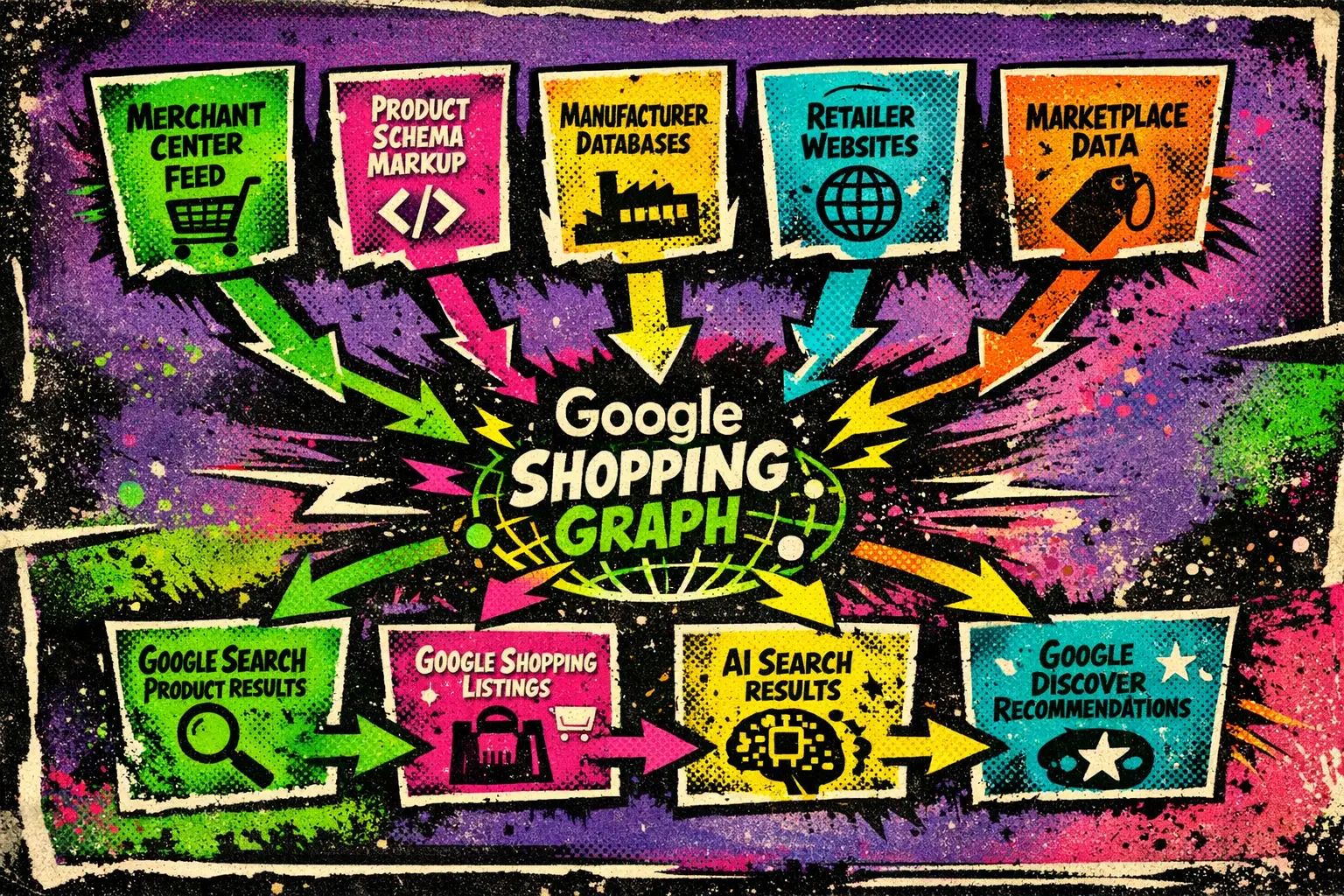
Today, Google increasingly ranks entities instead. Products, brands, locations, and services are mapped inside the Shopping Graph, a massive dataset connecting billions of products and sellers. This system does not rely on page copy. It relies on structured product data, with Merchant Center feeds, GTIN identifiers, schema markup, and manufacturer databases feeding directly into it. Your product feed is no longer just advertising data. It is a structured input into Google’s product knowledge graph.
Weak product data creates weak entity signals, which reduces visibility across every Google commerce surface.
Where Product Data Now Influences Visibility
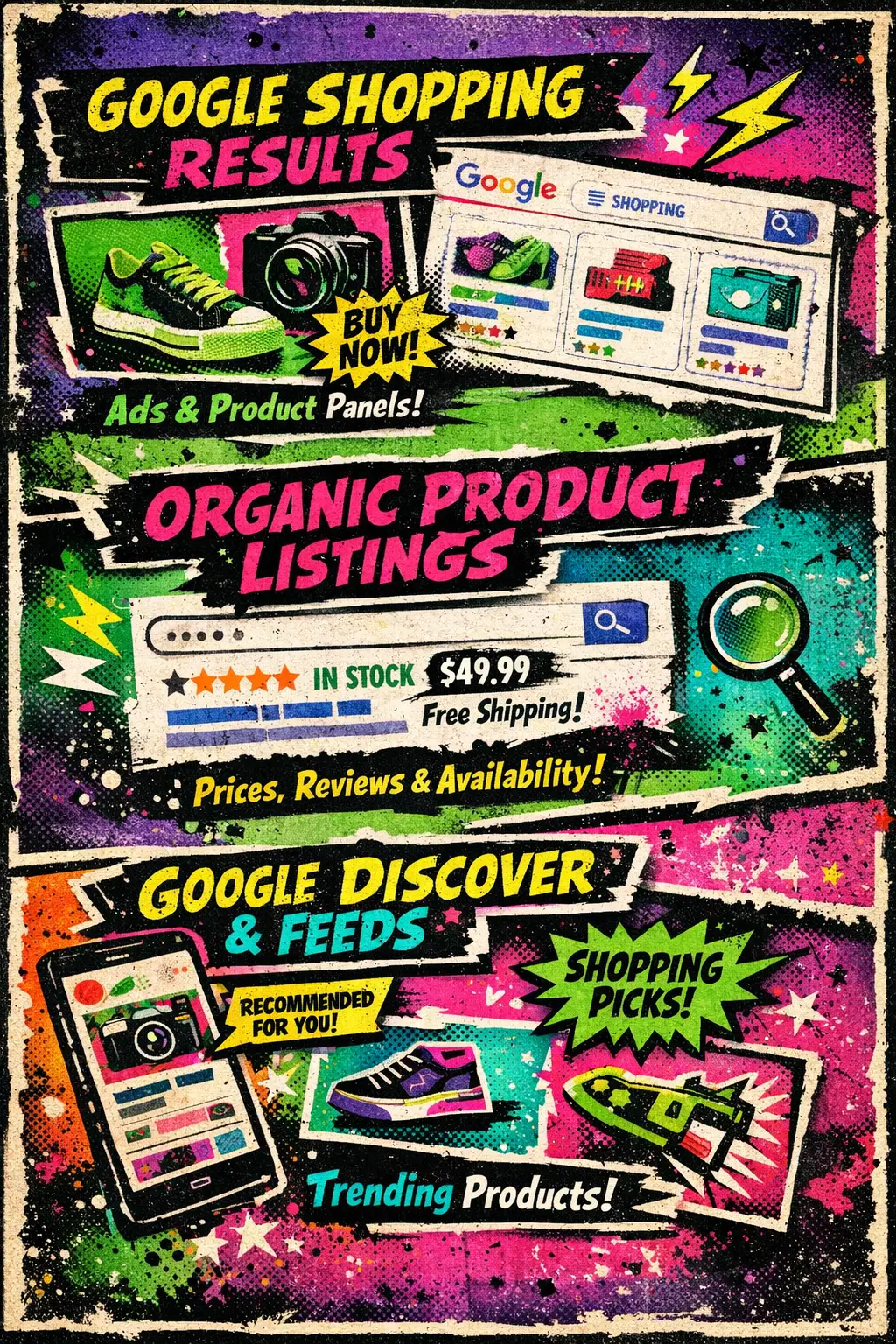
Product feeds no longer power one system. They power several!
Google Shopping Results
Merchant Center feeds determine which products appear in Shopping listings and product panels. Titles, attributes, identifiers, and pricing signals all influence relevance. These listings are no longer isolated either. Google increasingly blends Shopping results directly into the main search results.
Organic Product Listings
Google frequently pulls product information directly into organic search results, including pricing, availability, reviews, and delivery details. Much of this data comes from structured data and Merchant Center feeds. If the feed conflicts with the website, Google often trusts the feed. Pricing or stock mismatches can quietly reduce trust in your organic “In Stock” signals and suppress rankings for high-intent commercial queries.
AI Search Systems
AI search systems increasingly rely on structured product data. They do not read long product descriptions the way humans do. Instead, they retrieve attributes such as price, brand, compatibility, and specifications directly from structured datasets.
Product feeds and schema provide the exact inputs these systems prefer. Weak or incomplete product data reduces the chances of appearing in AI-generated product recommendations and summaries.
Google Discover & Shopping Feeds
Google Discover increasingly surfaces product recommendations and commercial content. These recommendations rely heavily on Merchant Center data and Shopping Graph signals. Once again, the feed becomes a visibility signal in a search surface that does not resemble traditional search results.
Why Product Feeds Are Becoming SEO Infrastructure
Google prefers structured information. A paragraph of copy might describe a product.
A product feed defines it precisely.
Feeds specify attributes such as:
brand model material size colour compatibility price availability category hierarchy product identifiers like GTIN
This precision allows Google to connect your product to its wider entity graph.
This makes feeds extremely valuable to search systems.
The feed becomes part of the relevance engine, not just an advertising dataset.
The Product Data Mistakes That Quietly Kill Visibility
Most e-commerce sites already have feeds and very few optimise them properly. Generic product titles are one of the most common issues. Many retailers simply export product names directly from their catalogue.
Example:
Manufacturer Title
SEO Optimised Title
X200 Pro
Nikon X200 Pro Mirrorless Camera Body 24MP Black
Model 785
Bosch Series 6 Dishwasher 60cm Stainless Steel SMS6ZCI00G
Context matters! Brand, product type, model and attributes help Google understand exactly what the product is.
Another major issue is missing product identifiers.
GTINs are critical. Think of them as the social security number of a product.
Without GTINs, Google cannot reliably match your listing to the wider product entity in the Shopping Graph. That weakens relevance signals across Shopping and Search.
Feed and page mismatches also create problems. Google constantly cross-checks feed data against the website.
Pricing mismatches, incorrect stock status, or inconsistent variants reduce trust.
Poor categorisation is another hidden problem. Google relies heavily on taxonomy signals to understand product relationships.
Incorrect or overly broad categories limit discovery across product surfaces.
Traditional SEO vs Product Data SEO
Traditional Ecommerce SEO
Product Data SEO
Optimises webpages
Optimises structured product data
Focus on content and internal linking
Focus on feed attributes and identifiers
Rankings based on page relevance
Visibility based on entity matching
Category page optimisation
Merchant Center feed optimisation
Keyword targeting
Product entity targeting
This shift does not replace traditional SEO, it adds a second layer, one that many teams are ignoring.
Why This Matters Now
Search is evolving from document retrieval to entity retrieval and Google is no longer just ranking pages.
It ranks products within a structured commerce graph.
Product feeds are structured representations of those entities which makes them extremely valuable to modern search systems.
The more Google relies on structured commerce data, the more product feeds influence visibility.
Which means feed optimisation becomes part of the SEO stack.
Why Product Data SEO Will Become a Major Service Category
Over the next 12 to 18 months, product data optimisation will become its own SEO discipline.
AI search relies heavily on structured entity data and product feeds provide that structure. Google is also merging Shopping results, organic product listings, AI product recommendations, and merchant data into a single ecosystem.
Feeds sit at the center of that ecosystem and optimising them influences multiple Google surfaces simultaneously.
Category pages and product descriptions still matter.
But structured product data increasingly determines how products appear across Google’s interfaces.
Product feeds are becoming part of the ranking environment.
This Is Exactly Where We Focus
Most agencies still treat product feeds as a PPC problem. We treat them as search infrastructure.
Product data optimisation includes feed auditing, attribute optimisation, schema alignment, GTIN health checks, and Merchant Center diagnostics.
Because the next phase of e-commerce SEO will not be decided by page copy alone, it will be decided by the quality of the product data feeding Google’s Shopping Graph.
The businesses that control that data will control visibility.
Ben Murphy is an SEO specialist with over 15 years of hands-on experience helping businesses grow through transparent, data-driven search strategies, having launched and scaled one of Manchester’s leading SEO agencies before relocating to Perth in 2025 to bring his proven methodology to the Australian market. Known for long-term client retention, measurable results, and a partnership-first approach, Ben now leads PunkFox with a focus on delivering senior-level expertise, honest guidance, and sustainable organic growth for brands across Perth and beyond.