Published on June 10, 2026
Is SEO Dead? No. Bad SEO Is.
By Ben Murphy
Every time search changes, someone says SEO is dead.
It happened with mobile. It happened with voice search. It happened when social media platforms started shaping discovery. And now it is happening again because of LLMs, AI chat tools, and Google’s AI Overviews.
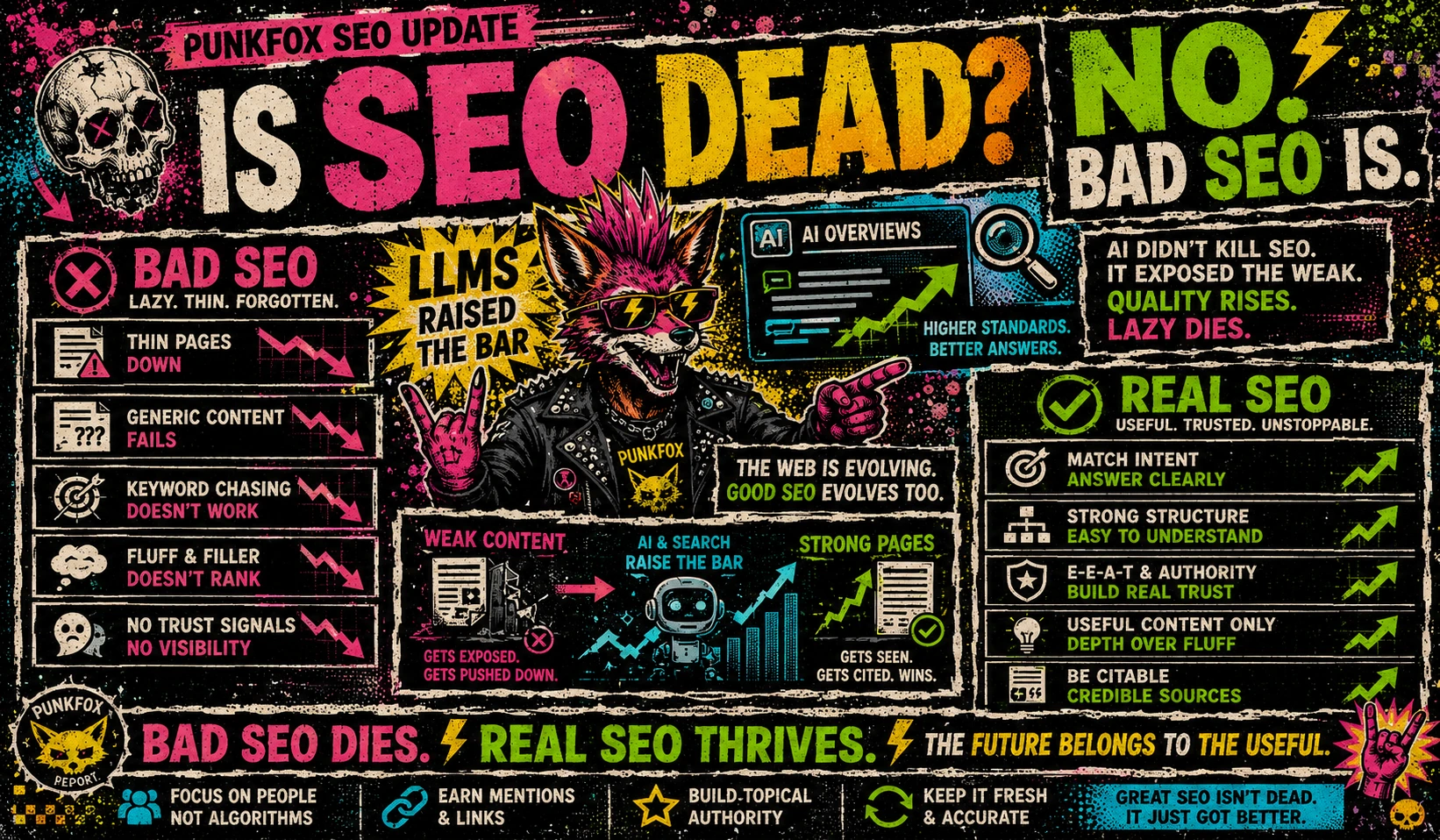
But SEO is not dead. What is actually dying is the lazy version of it.
Thin pages, vague service copy, generic blog posts, and content written to catch a keyword without actually helping a real person are all getting weaker. That version of SEO is losing oxygen because modern search engines and AI systems have less and less reason to rely on it. Real SEO is still doing what it has always done. It helps the right businesses get found.
LLMs did not kill SEO. They raised the bar.
A lot of people are acting like AI tools replaced search. They did not. They changed how people interact with information, how answers are surfaced, and how options are compared, but they did not remove the need for relevance, trust, authority, and discoverability. They just made those things more important.
AI systems do not invent reliable answers out of nowhere. They still depend on live web sources, crawling patterns, citations, and trusted signals to decide what is worth using.
Look at AI Overviews. They sit directly inside Google Search. That matters because they still depend on Google’s ability to find, retrieve, and assess strong sources before an answer is generated. If your SEO foundations are weak, your positioning is vague, and your site is hard to trust, there is no good reason an AI system should treat you like a premium source.
That is the bit too many people miss. The best AI visibility still comes from strong SEO execution.
The same fundamentals still do the heavy lifting.
If you want to be found in search engines and cited by AI tools, the core fundamentals still decide the outcome.
That means:
Matching search intent properly
Structuring content clearly
Making pages easy to scan and understand
Demonstrating real experience, expertise, authority, and trust
Publishing original insight that is actually useful
A lot of what people now call “AI optimisation” is just well-executed SEO with better structure, stronger evidence, and clearer trust signals.
Generic content is easier than ever to produce. That is exactly why useful content matters more now, not less.
Search intent matters more, not less.
One of the biggest mistakes in this conversation is assuming AI reduces the importance of search intent. It does the opposite.
If someone searches for a service, a comparison, a problem, or a highly specific question, the content that wins is still the content that feels like the best answer. Not the page with the most fluff. Not the page with the most keywords. The page that solves the problem clearly.
That has always been the best version of SEO. AI is just making the difference between strong intent matching and weak intent matching much easier to expose.
Reputation management is SEO now.
This is another layer people still try to separate when they should not.
If search engines and AI systems are deciding whether your business is worth surfacing, then your wider reputation matters more than ever. For local businesses, especially, this trust layer is huge.
That includes:
Google Business Profile quality and category alignment
Review quality, recency, and volume
Off-site mentions across directories, industry sites, and local sources
Consistent business details and brand positioning across the web
This is not a side task sitting next to SEO. This is SEO.
If your website says one thing, your reviews suggest another, and third-party sources barely back you up at all, that weakens your visibility, whether the search happens in Google, Maps, or an AI-generated answer.
If you want to be cited, you need to look citable.
This is where a lot of businesses get bypassed.
Pages full of vague marketing filler, padded intros, and interchangeable claims are easy for both search engines and AI systems to ignore. If you want to be selected as a source, your content needs to look credible, extractable, and worth quoting.
That usually means:
Clear authorship and obvious expertise
Direct answer structures under strong headings
Supporting evidence, examples, case studies, or first-hand insight
Content that sounds like it came from someone who actually knows the subject
Good SEO is not being replaced by AI. It is being filtered through it.
What is actually dying?
Bad SEO.
Lazy SEO.
Generic SEO.
The days of publishing dozens of slightly different pages and hoping that alone will do the job are getting weaker. The days of bland blog posts with no perspective, no proof, and no reason to exist are getting weaker, too.
That is not SEO dying. That is poor execution, losing its grip.
The businesses still winning are the ones doing the harder things properly: matching intent, creating better pages, proving expertise, earning trust, and showing up in credible places. That is still SEO. It is just better SEO than a lot of people were doing before.
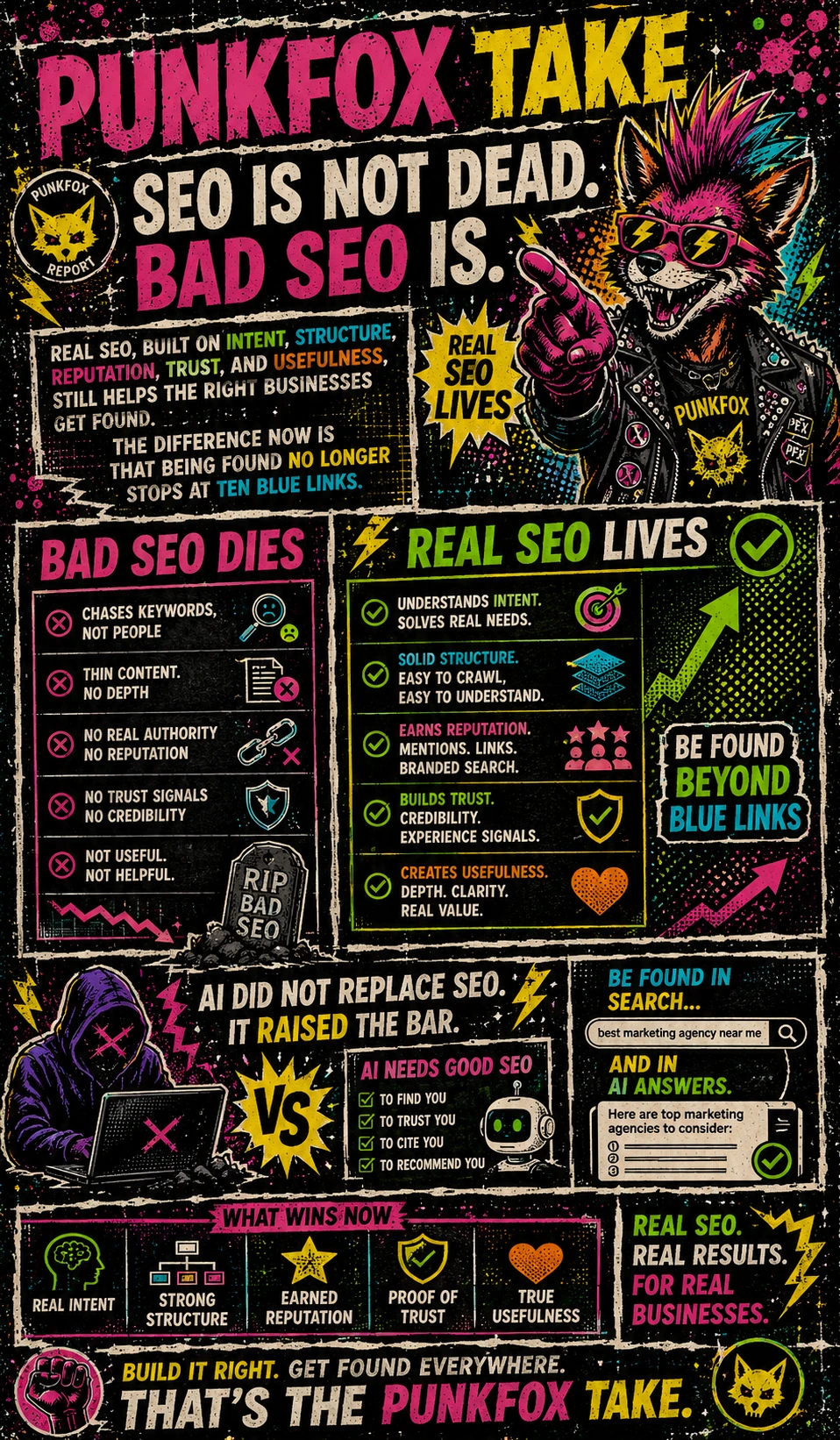
PunkFox take
SEO is not dead.
Bad SEO is.
Real SEO, the kind built on intent, structure, reputation, trust, and usefulness, is still doing exactly what it has always done. It helps the right businesses get found.
The only difference now is that being found no longer stops at ten blue links.