Published on April 1, 2026
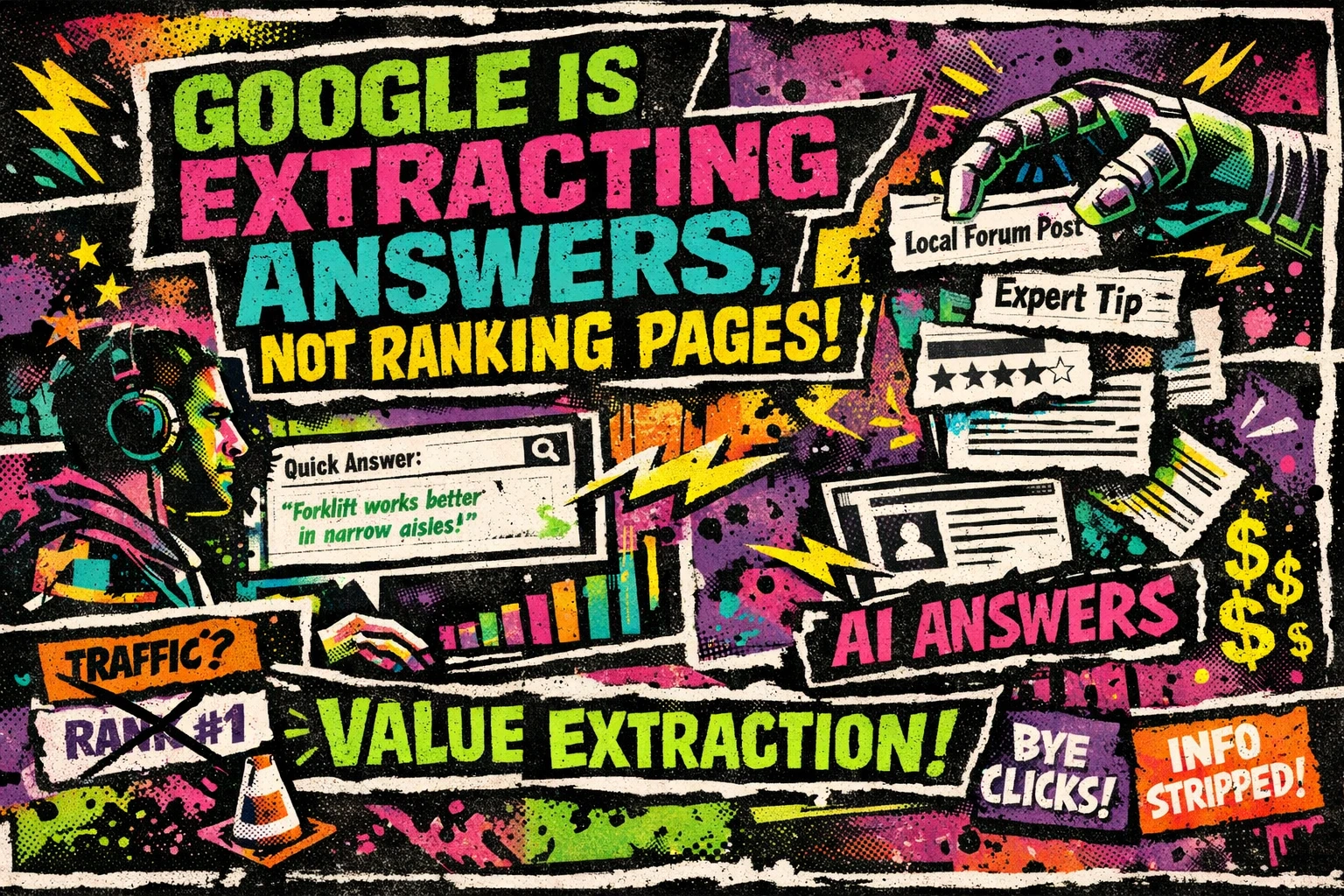
Google Is Extracting Answers, Not Ranking Pages
By Ben Murphy
For years, SEO worked on a simple assumption.
Google ranked pages. Users clicked results. Traffic followed rankings.
That model is breaking.
Google is no longer just deciding which page deserves position one. It is increasingly difficult to decide which fragment of information deserves to be extracted, summarised, and surfaced directly inside the search experience. That is a very different system, and most businesses are still optimising as if nothing has changed.
This is not just a zero-click problem. It is a value extraction problem.
The Shift Most Businesses Have Not Noticed
A lot of SEO conversations still focus on ranking movement. Did the page move up? Did impressions increase? Did clicks drop? Those questions still matter, but they are no longer the whole game.
Google is increasingly pulling useful fragments from pages, forums, reviews, Q&A content, and user discussions, then repackaging that information inside AI-generated answers, discussion modules, and expanded SERP features. In other words, Google no longer needs to rank your full page prominently to use what is on it.
That changes the economics of content.
Your page can contribute value to the search result without receiving the traffic that value used to generate.
Why Forum Content Is Becoming So Useful To Google
This is where most business content starts to lose.
A polished service page is built to present a business well. A forum comment is built to answer a question directly. Google increasingly prefers the second format when the goal is speed, clarity, and perceived authenticity.
That is why forums, discussion threads, Reddit comments, and niche communities keep appearing more often. It is not just that Google likes “real people”. These sources often provide short, specific, experience-led answers that are easy to extract.
A user asking whether a forklift works better in narrow warehouse aisles, or how much commercial cleaning typically costs in Perth, does not always need a full landing page. Sometimes, Google can satisfy the query with one extracted sentence from someone who sounds credible enough.
That is a problem if your website content is broader, safer, and less useful than the comment it is competing with.
Google Is Moving From Ranking Documents To Harvesting Utility
This is the real shift.
Traditional SEO was built on document retrieval. Google found the most relevant page and ranked it.
Modern search is moving toward utility retrieval. Google finds the most useful answer element, regardless of whether that utility lives inside a service page, a review, a forum comment, a product spec, or a FAQ.
That means websites are no longer only competing as pages. They are competing as sources of extractable value.
And if your content is too generic, too padded, or too obviously written to rank rather than help, Google can bypass it entirely.
The New Threat Is Not Lower Rankings
It is content strip-mining.
That sounds dramatic, but it is the most accurate way to describe what is happening. Google can take the strongest part of your content, use it to satisfy the query, and leave your page with the cost of production but none of the old traffic reward.
This is why some sites are seeing stable rankings and weaker clicks. It is also why some businesses feel like their content is “working” but not producing commercial returns. The content may still be visible in some form, but the user journey ends before the website visit happens.
SEO used to be about earning the click.
Now it is increasingly about surviving extraction.
Why Most Business Content Is Vulnerable
Most websites still produce content designed for old SEO systems. It is usually one of three things.
First, broad summary content that explains obvious topics without adding anything new. Second, a safe service copy that avoids saying anything specific enough to be memorable. Third, templated informational content that reads cleanly but offers no lived experience, no sharp opinion, and no information gain.
That type of content is easy for Google to summarise because it contains nothing that forces a user to visit the source.
If your page can be replaced by a neat answer box, it probably will be.
What Content Still Wins
The content that survives this shift tends to have one of four qualities.
It contains first-hand experience. It includes local or niche specificity. It presents original framing or a contrarian opinion. Or it includes information Google cannot cheaply reproduce from everywhere else.
That is why case studies matter more. That is why real-world examples matter more. That is why local context matters more. And that is why “I”, “we”, and actual experience signals are becoming commercially useful rather than stylistic choices.
Google can average generic content into a summary. It struggles more when the content carries a perspective, a scenario, or a real-world constraint that cannot be flattened without losing meaning.
This Is Also Why GEO Matters
If search is moving toward generated answers, then businesses need to think beyond ranking pages and start thinking about answer eligibility.
That is where GEO strategies start to matter. The question is no longer just whether your page ranks. It is whether your business, your website, and your content are structured clearly enough to be pulled into generated search experiences in the first place.
If Google is extracting answers, then being part of the answer layer matters as much as ranking in the classic blue-link layer.
That is not a future problem. It is already happening.
The Local Business Problem
This gets even more dangerous for local businesses.
If Google can answer “best emergency plumber in Perth”, “how much does dental SEO cost”, or “what is the average commercial cleaning quote” using a blend of reviews, forum posts, business profile data, and extracted snippets, then your traditional service page has to work much harder to earn the click.
This is why SEO strategies for Perth businesses can no longer rely on broad location pages and polished filler. If your site sounds less real than a forum post from Dave in Joondalup, Google has a very easy decision to make.
That may sound harsh, but it is exactly what is happening.
What To Do Now
The first step is to stop writing content purely to fill keyword gaps. If the page exists only because a keyword tool suggested it, it is probably vulnerable.
The second step is to increase information gain. That means adding real examples, real decisions, local detail, trade-offs, pricing context, operational realities, and first-hand observations that cannot be pulled from ten other sites.
The third step is to review your top-of-funnel content and ask a harder question than “is it optimised?”
Ask this instead.
If Google extracted the strongest sentence from this page, would a user still need to click?
If the answer is no, then the page is too replaceable.
This is also the right moment to request a free SEO audit if you want to know which pages on your site are likely to be extracted, ignored, or suppressed as AI search expands.
The Bigger Shift Behind This
This is not just Google adding a feature.
It is Google changing the relationship between search engines and websites. Websites used to be destinations. Now they are increasingly becoming sources. Some will still win traffic. Others will simply feed the system.
The businesses that keep treating SEO as a ranking exercise will struggle to understand why visibility no longer turns into visits.
The businesses that adapt will build content that Google cannot cheaply summarise, flatten, or replace.
That is the real game now.