Published on December 18, 2025
SEO is Now a Retrieval Game
By Ben Murphy
You will often hear Google say that optimising for AI-driven search is “just SEO”.
That statement is technically true, but dangerously incomplete.
Yes, the fundamentals still matter. Clear content, relevance, trust, and authority have not gone away. But how those fundamentals are evaluated has changed, and that change is happening right now.
If your SEO strategy is still built only around ranking pages, you are already behind. This is where a modern SEO agency in Perth needs to think beyond rankings and focus on how search actually works today.
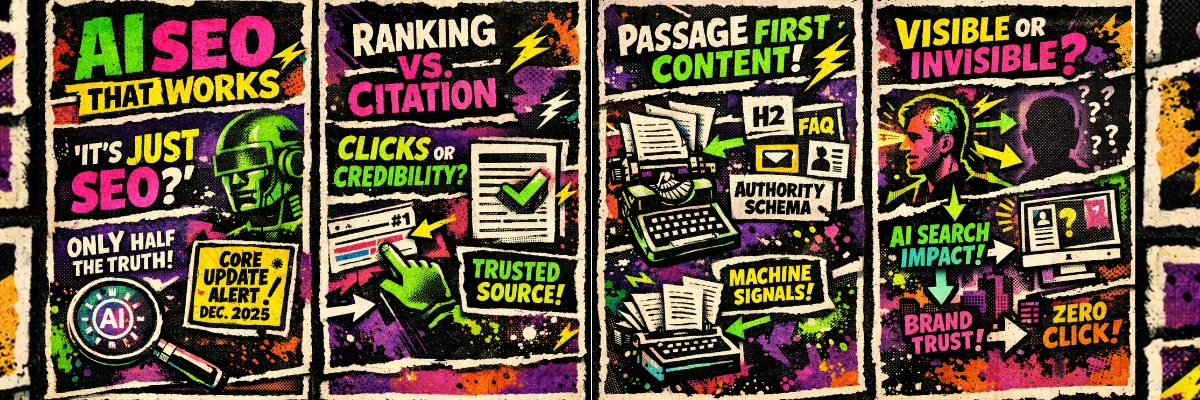
AI search is no longer deciding who ranks. It is deciding who is credible enough to be used as a source.
Current Update Alert: December 2025 Core Update
As of mid December 2025, Google is in the middle of a core update rollout that is aggressively filtering content quality.
We are seeing sites drop visibility, not because they broke rules, but because their content hits a word count without actually satisfying intent.
Pages built with unedited AI content, generic explanations, or no firsthand proof are being quietly removed from prominence. This is affecting both traditional rankings and AI driven visibility at the same time.
This update is not about punishment. It is about credibility.
The Part Google Doesn’t Say Out Loud
Traditional SEO was about pages.
AI-driven search is about passages.
In classic search, Google evaluated an entire page and decided where it should rank. In AI Overviews and generative results, Google retrieves small, self-contained chunks of information and assembles answers from them.
You can rank number one organically and still be invisible in AI results if your content cannot be easily extracted, understood, and trusted at a passage level.
This is why many strong-looking websites are losing visibility during this update without obvious technical issues.
Ranking Versus Citation: The Shift at a Glance
Traditional SEO and AI SEO solve different problems.
Traditional SEO aims to win a click.
AI SEO aims to be the source.
Here is the difference in practical terms.
Feature
Traditional SEO
AI SEO and GEO
Primary goal
Occupy a blue link position
Be the source of truth for the answer
Content unit
The entire page or URL
Self-contained passages or chunks
Main metric
Clicks and impressions
Share of model and citation rate
Format focus
Narrative flow
Direct answers and atomic retrieval
If your content only works as a long-form read, it will struggle in AI-driven search.
What AI Search Is Actually Filtering For
AI Overviews act like a source filter.
Google is no longer asking “Who should rank?” It is asking “Who can I safely quote?”. Find out more about Googles local ranking factors.
Generic advice does not survive this filter.
Vague service descriptions do not survive this filter.
Content that buries the answer does not survive this filter.
This is why Reddit threads, forum answers, and YouTube transcripts are frequently cited. They offer direct, experience based statements that AI systems can reuse confidently.
The Shift to GEO, Generative Engine Optimisation
Good SEO now requires a dual-track approach.
You still write for humans, but you must also structure content for retrieval.
At PunkFox, GEO means three practical changes.
Passage First Content Structure
AI does not read like a person. It retrieves answers.
Every major section of a page should begin with a direct answer of roughly forty to fifty words. That answer must stand on its own.
If the AI cannot extract a complete response from the opening sentences of a section, it will move on to a competitor who made the job easier.
This is one of the biggest visibility leaks we see during the current update.
Machine Readable Authority Signals
Headings are no longer just for readability. They act as intent markers.
Clear H2s and H3s tell AI systems what problem is being solved in each section. Combined with consistent language and semantic clarity, this dramatically improves retrieval.
Schema also matters again.
Organisation schema, Person schema, and FAQ schema help remove ambiguity around who you are, what you do, and why you are qualified to speak on a topic.
Authority is no longer implied. It is declared and verified.
From Keywords to Share of Model
Traditional SEO reporting focused on keywords and clicks.
AI-driven search introduces a new reality. Visibility without clicks.
That can sound uncomfortable until you understand where the conversion actually happens.
When an AI answer repeatedly references your brand as the expert, users do not click immediately. They remember you.
They then search for you by name.
This is where branded search grows, trust accelerates, and conversions occur. AI SEO is not replacing performance. It is becoming the top of the funnel that feeds it.
If the AI never mentions you, you are invisible, even if you technically rank well.
So Is Google Right When It Says “It’s Just SEO”?
Only if your definition of SEO has evolved.
If SEO means clarity, structure, proof, and authority, then yes. This is still SEO.
If SEO means chasing rankings with padded pages and hoping traffic follows, that version is being filtered out right now.
The December update is making that very clear.
AI search is not changing the rules. It is enforcing them with less tolerance than ever before.
The businesses that win are not chasing AI tricks. They are making it effortless for both humans and machines to understand exactly what they do and why they are credible.
That is where modern SEO now lives.
The natural next step is not more content. It is auditing what you already have to see whether it is built to rank, to be cited, or both.
A simple AI-ready content audit can reveal gaps in minutes that traditional SEO reviews often miss.