Published on December 23, 2025
Reputation as Verified Data in 2026
By Ben Murphy
Surviving Google’s 2026 Review Purge
For years, local SEO treated reviews as social proof. A star rating, a growing count, and the occasional response were usually enough to support visibility.
That model is breaking.
As Google’s search systems shift towards AI-driven retrieval, reviews are no longer just something people read. They are now data points used to verify whether a business exists, operates where it claims to, and delivers the services it describes.
This shift explains why review removals are accelerating and why many businesses are losing reputation signals without any obvious policy violations. In many cases, this leads to panic-driven SEO decisions that make visibility problems worse, not better.
Reviews are now used for semantic grounding.
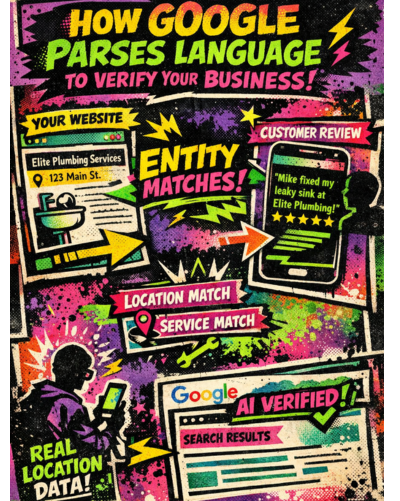
In 2026, Google does not just look at star ratings or review volume. It parses the language inside reviews to understand what actually happened in the real world.
When customers mention specific services, locations, staff names, or outcomes, those details help ground the business as a real entity. They independently confirm the claims made on the website and reinforce what the business says it does.
These details increasingly matter for AI Overviews and other retrieval-based experiences. Review snippets are often used to verify whether the information on a site aligns with what customers report in practice.
Generic praise adds very little here. Specific experiences do.
Google knows if the reviewer was actually there.
Another change catching many businesses off guard is how Google evaluates reviewer legitimacy.
Reviews are no longer assessed in isolation. They are cross-referenced against behavioural signals, including location data. If a review is submitted but the user’s device was never physically present at the business location, that review is far more likely to be discounted or removed.
This is especially relevant for service businesses and multi-location brands. Location-agnostic reviews, even if well written, carry less weight when they cannot be tied to a real-world visit.
Google is not guessing. It knows whether the reviewer was in the building.
Why review volume is becoming a liability
For years, businesses were encouraged to collect reviews at scale. Automated emails, templated prompts, and bulk campaigns worked because Google’s systems were less sensitive to patterns.
Now, those same patterns are a liability.
Large spikes in similar reviews, repeated phrasing across locations, or feedback that lacks context are easier to identify and easier to discount. In many cases, it is removed entirely.
The risk is not just losing reviews. It is weakening the trust signals that AI systems rely on to decide whether a business should be surfaced, cited, or ignored.
Incentivised reviews are now a detectable signal.
In late 2025, Google tightened how it classifies incentivised feedback, expanding Google’s review policies around fake engagement, incentives, and misleading content.. Reviews tied to discounts, gifts, or rewards are increasingly associated with explicit incentivisation attributes.
This matters because incentivised reviews are no longer simply filtered. They are used as contextual signals. When a business relies heavily on “review for a coffee” or “leave feedback for a discount” tactics, Google’s systems can map that behaviour and adjust how much confidence those reviews contribute.
In practical terms, incentivised reviews do not just disappear. They can actively weaken the overall trust profile of a business by signalling an attempt to manufacture consensus rather than earn it.
As AI-driven retrieval systems mature, these behavioural patterns become easier to detect and harder to ignore. Reviews are no longer isolated opinions. They are inputs into how the model evaluates credibility.
The shift from reviews to retrieval hooks
The goal is no longer to ask customers to “leave a review”.
The goal is to encourage customers to describe what actually happened.
Reviews that mention specific services, outcomes, or locations create retrieval hooks. They give AI systems language to connect a business to particular queries, intents, and contexts.
A review that says “They were great” adds very little. A review that says “They fixed our site speed issues and explained the changes clearly” reinforces expertise in a way AI systems can use.
This is not about scripting reviews. It is about prompting specificity.
How to build a resilient local reputation in 2026
The most resilient local businesses are not chasing volume. They are building consistency.
Their website, Google Business Profile, and reviews all tell the same story. Services are clearly defined. Locations are unambiguous. Content reflects what actually happens when someone engages with the business.
Reviews support that narrative rather than trying to replace it.
When reviews fluctuate or older ones are removed, these businesses see less impact because trust is distributed across the entire entity, not concentrated in one fragile signal.
What this means for local and multi-location brands
Google’s direction is clear. Reputation is no longer static proof. It is behavioural data.
Businesses that treat reviews as a transactional asset will struggle. Businesses that treat them as evidence of real-world activity will adapt.
In 2026, local SEO is not about protecting review counts. It is about making sure every signal, including reviews, reinforces the same grounded, verifiable story.
The question is no longer how many people say you are good.
It is whether Google’s systems believe you are real, relevant, and worth retrieving.